



Gold. Silver. Bronze. Platinum if you are feeling fancy.
These labels have been the default language of event sponsorship for decades. And in 2026, they are the fastest way to get a "we'll circle back" from a brand's marketing director.
The problem is not that sponsors have smaller budgets. Sponsorship spending in live events continues to climb. The problem is that a tier name tells a sponsor nothing about what they are actually buying. And when a CFO asks "what did we get for that $10K?", a gold badge on a banner is not an answer.
This article breaks down how to price event sponsorship packages based on the value of specific activations rather than the prestige of a tier name. You will walk away with a pricing framework, three ready-to-use package examples, and a method for proving ROI to sponsors after the event.
Why Tier-Based Sponsorship Pricing Is Failing
The traditional sponsorship model works like a restaurant prix fixe menu. You pick a tier, you get a bundle of items, and you hope something in that bundle matters to you.
Here is what that looks like in practice:
- Gold ($10,000): Logo on website, banner at event, 10 VIP tickets, social media mention
- Silver ($5,000): Logo on website, banner at event, 5 VIP tickets
- Bronze ($2,000): Logo on website, 2 VIP tickets
The sponsor sees logos and tickets. Their CFO sees a cost center. Nobody sees measurable outcomes.
Sponsors in 2026 are not buying visibility. They are buying data, leads, and attributable engagement. They want to know how many people interacted with their brand, how many emails they captured, and what those attendees said in a post-activation survey. If your package cannot answer those questions before the event starts, you are competing on price alone.
The Activation-Based Pricing Framework

Instead of naming tiers, price each sponsorship package based on the specific activations included and the measurable value those activations produce.
The shift looks like this:
| Old Model (Tier-Based) | New Model (Activation-Based) |
|---|---|
| Logo placement on banner | Branded sweepstakes with email capture |
| "Presented by" naming | Post-event survey with sponsor questions |
| VIP tickets included | Upsell integration with sponsor product |
| Social media mention | Lead count with verified contact data |
| Arbitrary tier label | Projected ROI based on activation metrics |
Every activation in the new model produces a number. That number is what you price against.
How to Calculate the Value of Each Activation
Before you set a price, you need to know what each activation is worth to a sponsor. Here is a simple formula you can use.
The Activation Value Formula
Activation Value = (Projected Reach x Engagement Rate x Value Per Engagement)
- Projected Reach is the number of attendees who will see or have the opportunity to interact with the activation.
- Engagement Rate is the percentage who actually interact. For digital activations like sweepstakes or surveys, this typically runs between 15-40% depending on the incentive.
- Value Per Engagement is what a single interaction is worth to the sponsor. A verified email lead in most B2C categories is worth $5-$15. A completed survey response is worth $8-$25. A branded impression with dwell time is worth $0.10-$0.50.
Pricing Framework Table
Use this table to build your packages from the ground up.
| Activation Type | Avg. Engagement Rate | Value Per Engagement | Example: 1,000 Attendees | Example: 5,000 Attendees |
|---|---|---|---|---|
| Branded Sweepstakes (email capture) | 25-35% | $5-$12 per lead | $1,250-$4,200 | $6,250-$21,000 |
| In-App Survey (3-5 questions) | 15-25% | $8-$25 per response | $1,200-$6,250 | $6,000-$31,250 |
| Upsell Integration (sponsor product) | 10-20% | $3-$8 per click-through | $300-$1,600 | $1,500-$8,000 |
| Push Notification / Announcement | 40-60% | $0.10-$0.30 per impression | $40-$180 | $200-$900 |
| Post-Event Report with Analytics | Flat value | $500-$2,000 | $500-$2,000 | $1,000-$3,000 |
Now you have a range. Price your packages at the midpoint of that range, and you can show sponsors exactly how you arrived at the number.
Three Activation-Based Packages You Can Use Today
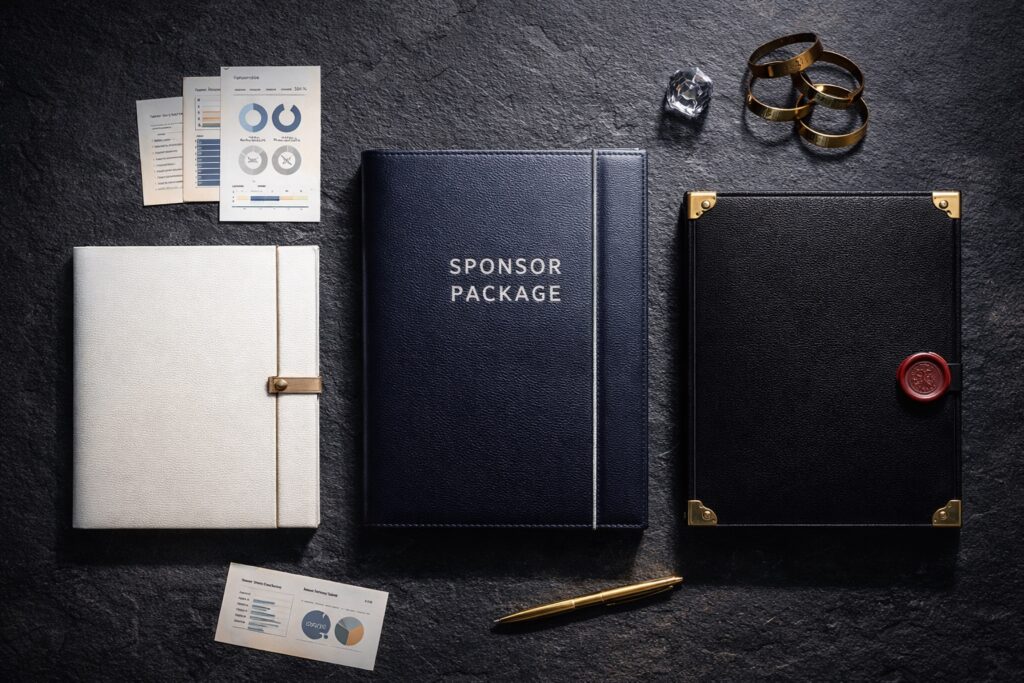
Below are three example packages at different price points. Each one is built around specific, measurable activations rather than vague tier benefits. Adjust the numbers based on your event size and audience demographics.
The $1,000 Package: "Lead Capture Starter"
Best for: Local businesses, emerging brands, first-time event sponsors
Event size assumption: 500-1,500 attendees
This package gives a sponsor their first taste of digital activation without a major commitment. It is designed to prove the model so they come back at a higher level.
Includes:
- 1 branded sweepstakes with email capture (projected 150-400 verified leads)
- Sweepstakes promoted via 2 push notifications to all ticket holders
- Sponsor logo and messaging on the sweepstakes landing page
- 3 custom survey questions appended to the sweepstakes entry form
- Post-event report with lead list, survey responses, and engagement metrics
- 2 complimentary event tickets
Why it works for the sponsor: At $1,000 for an estimated 200+ verified leads with survey data attached, the cost per lead lands between $3-$5. That undercuts most digital advertising channels. The sponsor walks away with a contact list, audience insights from the survey, and a clear metric to show their team.
The $5,000 Package: "Audience Intelligence"
Best for: Regional brands, product launches, sponsors running quarterly campaigns
Event size assumption: 2,000-5,000 attendees
This package is where sponsors start getting serious about using events as a data channel. The activations here generate both leads and behavioral data.
Includes:
- 1 branded sweepstakes with email capture (projected 500-1,500 verified leads)
- 1 standalone in-app survey (5 custom questions, projected 400-1,000 responses)
- 1 upsell integration featuring sponsor's product or offer within the ticket purchase flow
- Sweepstakes promoted via 4 push notifications across the event lifecycle (pre-event, day-of, during, post-event)
- Sponsor branding on the event's digital ticket and confirmation page
- Dedicated analytics dashboard showing real-time engagement during the event
- Post-event report with full lead list, survey analysis, upsell conversion data, and engagement breakdown
- 6 complimentary VIP tickets
Why it works for the sponsor: The combination of sweepstakes leads, survey responses, and upsell conversion data gives the sponsor three distinct data streams from a single event. At $5,000 for 500+ leads and 400+ survey responses, the per-unit economics are strong. More importantly, the survey data gives them market research they would pay a firm $15,000-$30,000 to produce independently.
The $15,000 Package: "Full Funnel Activation"
Best for: National brands, agencies buying on behalf of clients, multi-event sponsors
Event size assumption: 5,000-15,000 attendees
This is the flagship package. It gives the sponsor ownership of the digital experience layer across the entire event, from ticket purchase to post-event follow-up.
Includes:
- 2 branded sweepstakes campaigns (1 pre-event for hype building, 1 day-of for on-site engagement; projected 2,000-5,000 combined verified leads)
- 2 standalone surveys (1 pre-event audience profiling survey, 1 post-event brand recall survey; projected 1,500-3,500 combined responses)
- 3 upsell integrations featuring sponsor products or offers at different points in the attendee journey (ticket purchase, check-in, post-event)
- Unlimited push notifications with sponsor messaging throughout the event lifecycle
- Sponsor branding across all digital touchpoints: ticket, confirmation page, event app, and sweepstakes pages
- Exclusive "presented by" digital branding (not a banner, but integrated into the attendee's mobile experience)
- Real-time analytics dashboard with live engagement tracking during the event
- Post-event deliverable: full lead database, survey analysis report, upsell conversion funnel, and audience demographic breakdown
- Dedicated account support for activation setup and optimization
- 15 complimentary VIP tickets with backstage or exclusive access
Why it works for the sponsor: At $15,000, a national brand is paying roughly $3-$5 per verified lead with survey data and behavioral signals attached. Compare that to trade show booths ($15,000-$50,000 for a fraction of the leads) or digital campaigns ($20-$80 per qualified lead in competitive categories). The pre-event and post-event survey pairing also gives the sponsor a brand lift study, which research firms charge $25,000+ to conduct.
How to Pitch Activation Packages to Sponsors
The pitch changes when you move from tiers to activations. You are no longer selling exposure. You are selling a measurable outcome with a projected ROI.
Lead With the Math
Open your pitch with the numbers. "Based on our last 3 events averaging 4,000 attendees and a 28% sweepstakes engagement rate, this package will deliver approximately 1,100 verified email leads with survey data attached. At $5,000, that is $4.50 per qualified lead."
No sponsor has ever said no to a pitch that starts with unit economics.
Show the Economic Footprint
Events are not isolated moments. Research from Oxford Economics shows that every $100 a visitor spends on a concert ticket generates $334.92 in additional local spending. When you pitch a sponsor, you are not just selling access to your attendees. You are selling access to people who are actively spending money in the surrounding ecosystem. Frame this in your pitch deck. Sponsors are buying into a micro-economy that extends far beyond the venue.
Use Past Event Data as Proof
If you have run digital activations before, your historical data is your strongest sales asset. Show sponsors the engagement rates, lead volumes, and survey completion rates from previous events. Nothing closes a deal faster than proof that the model works.
Automate the Money Side
Pricing the package is half the challenge. The other half is making sure the money flows correctly after the deal is signed.
If you are managing multiple sponsors per event, each with a different package value and payout structure, manual revenue tracking will break. Spreadsheets introduce errors. Delayed payouts erode trust. And reconciling revenue across multiple events with different sponsor splits is a full-time job nobody wants.
This is where automated revenue splitting becomes essential. When a sponsor's package includes upsell integrations or sponsored ticket bundles, the revenue from those transactions needs to be attributed and distributed automatically. Set the split once, and every transaction flows to the right account without manual intervention.
For sponsored ticket bundles specifically, make sure your fee structure is transparent to both the sponsor and the ticket buyer. Hidden fees in a sponsored bundle will damage the sponsor relationship and increase cart abandonment.
Prove It After the Event
The sale does not end when the sponsor signs the check. It ends when they see the results and decide to come back next year at a higher price point.
Your post-event deliverable should include:
- Lead volume: Total verified contacts captured through sweepstakes and surveys
- Engagement rates: Percentage of attendees who interacted with each activation
- Survey insights: Aggregated responses to sponsor-specific questions
- Upsell performance: Click-through rates and conversion data on sponsor product integrations
- Audience demographics: Age, location, and behavioral data from the attendee base
- Benchmark comparison: How this event's metrics compare to industry averages and your own historical data
With analytics tools like TicketBlox Sense, this data is captured automatically across every activation. You are not building a report from scratch. You are exporting a dashboard that already exists.
This is the report that turns a one-time sponsor into a recurring partner. And it is the report that justifies a price increase on next year's package.
Common Mistakes When Pricing Sponsorship Packages
Pricing based on what you need, not what the activation is worth. Your event budget gap is not the sponsor's problem. Price based on the value they receive, not the revenue you require.
Offering too many activations in lower-tier packages. If the $1,000 package includes everything except the analytics dashboard, there is no reason to buy the $5,000 package. Create clear value gaps between price points.
Not including a post-event report. Without data, the sponsor has no internal justification for renewing. The report is not a bonus. It is part of the product.
Ignoring the renewal conversation. The best time to pitch next year's sponsorship is within 2 weeks of delivering the post-event report, while the data is fresh and the results are tangible.
FAQ
How do I price event sponsorship packages if I have never sold sponsorship before?
Start with the activation value formula above and use conservative engagement rate estimates (the low end of each range). Price your first packages 10-15% below the calculated value to reduce friction for early sponsors. Once you have one event's data proving the engagement rates, adjust your pricing to reflect actual performance.
What is the difference between tier-based and activation-based sponsorship pricing?
Tier-based pricing assigns sponsors to a named level (Gold, Silver, Bronze) with a bundled set of benefits, most of which are passive visibility items like logo placements. Activation-based pricing builds each package around specific, measurable interactions such as sweepstakes entries, survey responses, and upsell conversions. The key difference is accountability. Activation-based packages give sponsors a projected ROI before the event and proven metrics after it.
How many sponsorship levels should an event offer?
There is no fixed rule, but three to four price points typically cover the range of sponsor budgets without overcomplicating your sales process. More important than the number of levels is the clarity of what each level includes. Every package should have a distinct set of activations that justify the price gap between it and the next level down.
Can I customize sponsorship packages for individual sponsors?
Yes, and you should. The example packages in this article are starting templates, not rigid products. The best sponsorship deals happen when you tailor the activation mix to a specific sponsor's goals. A CPG brand might prioritize survey responses for product research. A tech company might want upsell integrations to drive app downloads. Build from the framework and adjust based on what the sponsor actually needs.
How do I prove sponsorship ROI to sponsors after the event?
Deliver a post-event report that includes lead counts, engagement rates, survey data, and upsell conversion metrics for every activation in the package. Use analytics tools that capture this data automatically during the event so the report is accurate and available within days of the event ending, not weeks. The faster you deliver results, the faster you close the renewal.
Sponsorship pricing does not have to be guesswork. When you build packages around measurable activations and back them with real data, you stop competing on brand prestige and start competing on value. That is a conversation every sponsor wants to have.
Ready to build activation-based sponsorship packages with built-in analytics, sweepstakes, surveys, and automated revenue splitting? Book a Demo and see how TicketBlox makes it work.