



Every conference panel in 2025 promised that AI would "revolutionize" events. Most of those panels were wrong — not because AI lacks capability, but because the promises were vague.
The real shift is quieter and more specific. AI event management is not about replacing your team with robots. It is about handling the volume spikes, data processing, and real-time pattern recognition that no human team can do at scale, no matter how talented they are.
Here are five ways AI is actually deployed in event management right now — with concrete before-and-after scenarios from real operations.
1. AI Customer Support That Handles 80% of Event-Day Inquiries
The old way: You staffed 3-4 support people on event day. They fielded the same questions over and over. "Where's my ticket?" "Can you resend my confirmation?" "Where do I park?" "What time do doors open?" Meanwhile, actual problems — a VIP whose comp tickets never arrived, a group order with the wrong quantity — sat in queue behind 40 parking questions.
The new way: An AI support agent handles ticket lookup, re-delivery, FAQ responses, and venue directions without human intervention. Your support staff still exists, but they handle the edge cases that require judgment. The AI handles volume. Humans handle nuance.
This is not theoretical. TicketBlox's Merlin AI operates as the first line of support for event promoters. Attendees get instant answers to standard inquiries. Promoters stop drowning in repetitive messages during the highest-stress hours of their event.
The math matters here. If your event draws 5,000 attendees and 8% contact support (industry average), that is 400 inquiries. With AI handling 80% of those, your human team sees 80 tickets instead of 400. That is the difference between a calm team and a burned-out one.
2. Predictive Audience Analytics That Replace Gut Feeling
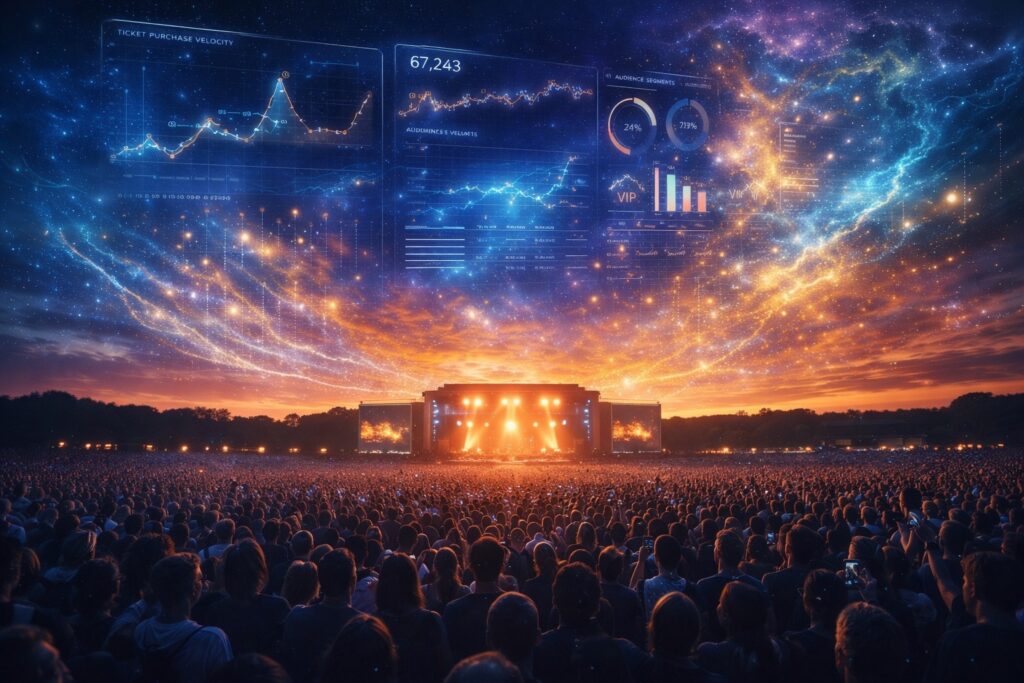
The old way: You booked the same headliner because "they did well last time." You assumed your audience skewed 21-30 because that is who you saw in the crowd. You had no idea that 35% of your buyers never actually showed up, or that your highest-spending segment was the 30-45 age group buying VIP tables.
The new way: AI segments your buyer base by actual behavior — purchase timing, ticket tier selection, add-on purchases, attendance history, survey responses. It predicts no-show rates by segment. It identifies your high-value repeat attendees so you can treat them differently than first-time buyers.
This changes decisions. When you know that your VIP buyers are 40% more likely to attend on Saturdays, you stop scheduling your premium experiences on Fridays. When you know that buyers who purchase within 48 hours of announcement have a 92% attendance rate versus 61% for last-minute buyers, you adjust your marketing spend accordingly.
Understanding your audience through data is the foundation. AI just processes that data faster and finds patterns you would never spot manually. TicketBlox Sense surfaces these segments and predictions automatically — no data science degree required.
3. Automated Marketing That Stops Treating Every Buyer the Same
The old way: You wrote one email. You sent it to your entire list. Open rate: 18%. Click rate: 2%. You called that "email marketing."
The new way: AI optimizes three layers simultaneously.
Subject lines. AI tests variations and learns which framing works for which segments. Your VIP buyers respond to exclusivity language. Your general admission buyers respond to urgency. Same event, different message.
Send timing. Not everyone checks email at 10 AM on Tuesday. AI learns individual open patterns and delivers each message at the optimal window. This alone can lift open rates by 15-25%.
Micro-segmentation. Instead of "everyone who bought a ticket last year," you build segments like "attended 2+ events, bought VIP, lives within 30 miles, opened last 3 emails." Then you send those people a different sequence than someone who bought one GA ticket 11 months ago and never opened a follow-up.
TicketBlox Boomerang CRM handles this natively — unlimited contacts, zero per-contact fees, and AI-driven send optimization built in. No need to export your buyer data to a third-party email tool and lose half your segments in the process.
The before/after is stark. Promoters who switch from blast-and-pray to AI-driven sequences typically see email revenue contribution double within two event cycles.
4. Dynamic Pricing Intelligence That Responds to Demand Signals

The old way: You set three pricing tiers at launch — Early Bird, Regular, VIP. You picked the prices based on what felt right, maybe benchmarked against a competitor. If Early Bird sold out in two hours, you left money on the table. If Regular stalled at 40% sold, you panicked and ran a discount that trained your audience to wait for deals.
The new way: AI monitors demand signals in real time — sales velocity, page views, cart additions, social mentions, comparable event benchmarks — and recommends tier transitions. When Early Bird hits a velocity threshold, the system nudges the transition earlier. When a pricing tier stalls, it identifies whether the issue is price, awareness, or timing.
This is not surge pricing. Nobody wants to feel gouged. It is intelligent tier management. The tiers you already planned to use simply activate at the right moments based on actual demand rather than arbitrary calendar dates.
The result: you capture more revenue from high-demand periods and avoid the panic-discount cycle during slower ones. Promoters using demand-informed tier transitions report 10-15% higher per-ticket revenue without increasing the sticker price on any individual tier.
TicketBlox is building toward this as part of its operating system approach to live events — where ticketing, pricing, marketing, and analytics are interconnected rather than siloed in different tools.
5. Real-Time Operational Intelligence on Event Day
The old way: You walked around the venue and hoped things looked fine. If check-in lines were backing up, you found out when attendees started posting complaints on social media. If a support issue was snowballing, you learned about it 45 minutes too late.
The new way: A live operations dashboard powered by AI surfaces anomalies before they become crises. Check-in velocity dropping at Gate B? Flagged. Support ticket volume spiking around a specific ticket type? Flagged. Scanning errors increasing in one zone? Flagged.
This is not a static dashboard with charts you have to interpret. AI watches the patterns and tells you what is deviating from expected baselines. You go from flying blind to running a command center.
Day-of operations have always been the highest-stakes phase of any event. The difference between a good event and a great one is often how fast you catch and resolve small problems before attendees notice them. AI gives you that speed.
TicketBlox Sense provides this real-time operational layer — surfacing the signals that matter from the noise of thousands of simultaneous data points across scanning, support, sales, and attendance.
The Skepticism Is Fair. Here Is the Honest Answer.
If you are reading this thinking "AI is overhyped and my events are fine without it," that is a reasonable position. Most AI marketing is hype.
Here is what AI actually does well in event management: it processes volume and speed that humans cannot match. No human can read 400 support messages in 10 minutes and respond to each one accurately. No human can monitor 12 check-in gates simultaneously and detect a slowdown at Gate B within 30 seconds. No human can test 47 email subject line variations across 15 segments and optimize send times for 20,000 individuals.
AI is not replacing your event team. Your team still makes the creative decisions, handles the VIP guest who needs a personal touch, solves the vendor crisis that requires negotiation, and creates the atmosphere that makes your event worth attending.
AI handles the parts that were either impossible at scale or so tedious that they never got done properly. That is the honest pitch. No more, no less.
Where This Goes Next
The next phase of AI event management is not more features. It is better integration. When your support AI, your marketing automation, your pricing intelligence, and your operational dashboards all share the same data layer, they compound. Your support AI learns from your marketing segments. Your pricing intelligence learns from your operational patterns. Your analytics learn from everything.
That interconnected approach is exactly why platforms matter more than point solutions. Five disconnected AI tools create five disconnected datasets. One platform with AI woven through the entire event lifecycle creates a flywheel.
If you are running events and want to see what AI-powered event management looks like in practice — not in a pitch deck — book a demo with TicketBlox and we will walk you through Merlin, Sense, and Boomerang with your actual event data.
Frequently Asked Questions
What is AI event management?
AI event management refers to using artificial intelligence tools across the event lifecycle — from marketing and ticket sales to day-of operations and post-event analysis. It includes automated customer support, predictive audience analytics, dynamic pricing, personalized marketing, and real-time operational monitoring. The goal is not to replace event professionals but to handle high-volume, data-intensive tasks that are impossible to do manually at scale.
How does AI improve customer support for events?
AI support agents handle repetitive, high-volume inquiries like ticket lookup, confirmation re-delivery, FAQ responses, and venue directions. This typically covers 80% of event-day support volume. Human support staff then focus on complex issues that require judgment and personal interaction. The result is faster response times for attendees and less burnout for your team during peak hours.
Can AI actually predict event attendance and no-show rates?
Yes. By analyzing historical purchase data, buyer behavior patterns, ticket tier selection, and timing of purchases, AI models can predict no-show rates by audience segment with useful accuracy. For example, last-minute buyers consistently show lower attendance rates than early purchasers. These predictions help promoters plan staffing, catering, and venue logistics more effectively.
Is dynamic pricing the same as surge pricing?
No. Dynamic pricing in events typically means intelligent tier transitions — moving between pre-planned pricing tiers based on actual demand signals rather than arbitrary dates. It is not about raising prices on individual buyers in real time. The tiers and price points are set by the promoter. AI simply recommends when to transition between them based on sales velocity and demand patterns.
How do I get started with AI tools for my events?
Start with the area causing the most friction. If your team drowns in support messages on event day, start with AI customer support. If you are guessing about your audience, start with analytics. The key is choosing a platform where these tools share data rather than operating in silos. Book a demo with TicketBlox to see how Merlin AI, Sense analytics, and Boomerang CRM work together across the full event lifecycle.