


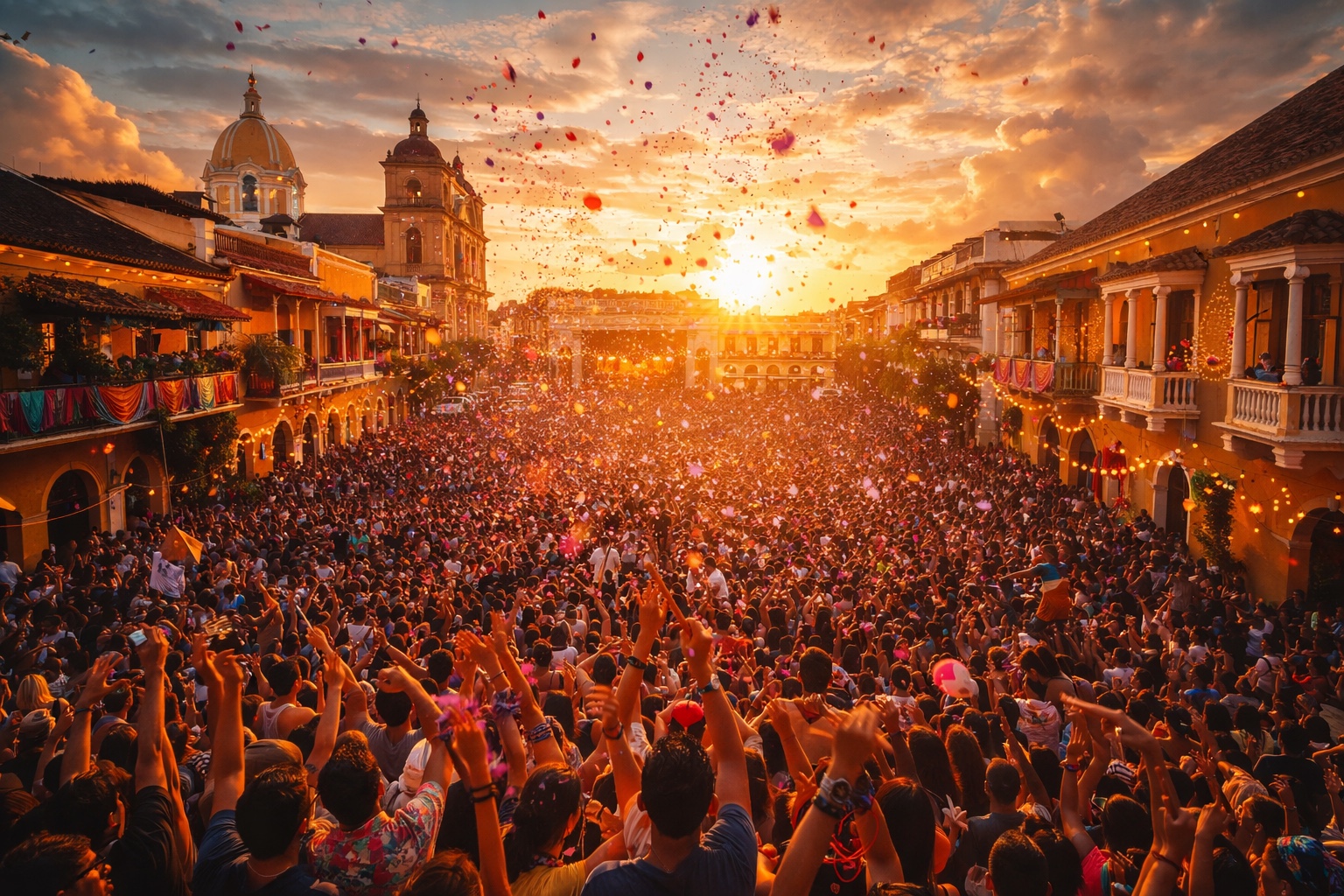
Latin America's live entertainment market is growing at 12-15% annually. That is two to three times the pace of the United States and Western Europe. Brazil, Mexico, Colombia, and Argentina are driving the bulk of that growth, fueled by a young, urban population that treats live events not as entertainment but as culture.
EDC just announced its Colombia expansion for October 2026. Ultra's RESISTANCE brand sold out Medellin in hours. Lollapalooza Brasil, Argentina, and Chile continue to break attendance records year after year.
The demand is not a question. The infrastructure behind it is.
And that gap between demand and infrastructure is where the real opportunity lives for event promoters and ticketing platforms willing to build for how Latin America actually works.
The Numbers Behind the Boom
The global online event ticketing market is projected to hit $105 billion by 2031. Latin America's share of that is growing disproportionately fast, and the region is still massively underdigitized compared to North America or Europe.
Here is what is happening on the ground:
- Brazil is the largest live entertainment market in Latin America, with Sao Paulo alone hosting more than 15,000 events per year. The country's instant payment system, PIX, has fundamentally changed how money moves.
- Mexico has a booming festival circuit and a massive urban youth population. Mexico City, Guadalajara, and Monterrey are becoming year-round event cities.
- Colombia is the fastest-growing market in the region. Bogota and Medellin have become global destinations for electronic music, reggaeton tours, and independent cultural events.
- Argentina has a passionate live events culture despite its economic volatility. Buenos Aires consistently ranks among the top live music cities in the world.
Together, these four countries represent the vast majority of LATAM's live event ticket sales. And in each one, the infrastructure that promoters rely on is fragmented, manual, and outdated.
How Most LATAM Promoters Actually Operate
Walk into the back office of a mid-size promoter in Bogota or Guadalajara and you will find a familiar setup:
- WhatsApp is the primary communication tool. Sales updates, artist coordination, vendor management, and customer support all run through group chats.
- Cash at the door still accounts for a significant portion of ticket revenue, especially outside major cities.
- Spreadsheets track sales, guest lists, and revenue splits. Sometimes Google Sheets. Sometimes Excel files passed around on WhatsApp.
- Bank transfers happen manually, often days or weeks after the event.
There is no single platform tying it together. No real-time dashboards. No automated payouts. No CRM capturing buyer data for the next event.
This is not a technology literacy problem. LATAM promoters are sharp operators who have figured out how to sell thousands of tickets using nothing but Instagram stories and WhatsApp broadcasts. The problem is that the tools built for North American and European markets do not account for how business actually gets done in Latin America.
Why Global Platforms Fail in Latin America
Eventbrite entered Latin America years ago. So did a handful of other US and European platforms. Most have stalled or retreated.
Here is why:
Delayed payouts destroy cash flow. Eventbrite pays out 3 days after an event ends, with an additional 5-7 business days for international bank processing. For a LATAM promoter who needs to pay the venue, the sound engineer, and the security team before the next weekend, that timeline is a dealbreaker. In markets where margins are thin and cash flow is oxygen, waiting two weeks for your own money is not a minor inconvenience. It is an existential threat.
No local payment methods. A checkout page that only accepts Visa and Mastercard misses a huge portion of the LATAM market. In Mexico, millions of people pay through OXXO, a cash-based convenience store network. In Colombia, Nequi and PSE dominate. In Brazil, PIX processes more transactions than credit cards. In Argentina, MercadoPago is the default. If your platform does not support these methods, you are invisible to a large segment of ticket buyers.
Fee structures ignore local economics. A percentage-based fee that works in the US becomes punishing in markets with lower average ticket prices. When the average ticket costs $15 USD equivalent and the platform takes 10-15% in fees plus payment processing, the math stops working for promoters.
No WhatsApp integration. WhatsApp is not just a messaging app in Latin America. It is the internet. It is how people discover events, share links, confirm attendance, and receive tickets. A platform that cannot distribute tickets via WhatsApp or enable promoters to share purchase links through WhatsApp is fundamentally disconnected from how LATAM audiences behave.
Language and localization gaps. Running a Spanish-language event through an English-first platform creates friction at every step, from the checkout page to the confirmation email to the customer support experience. Portuguese-speaking Brazil adds another layer entirely.
Eventbrite was recently acquired by Bending Spoons in a $500 million deal that closed in March 2026. The platform is now prioritizing profitable growth in core English-speaking markets: the US, UK, Canada, and Australia. Latin America is not the priority.
LATAM Market Comparison: The Big Four
| Brazil | Mexico | Colombia | Argentina | |
|---|---|---|---|---|
| Est. Market Size | Largest in LATAM | 2nd largest | Fastest growing | 4th, volatile |
| Key Payment Methods | PIX, MercadoPago, Boleto | OXXO, SPEI, MercadoPago | Nequi, PSE, Daviplata | MercadoPago, cash, Uala |
| Primary Currency | BRL (Brazilian Real) | MXN (Mexican Peso) | COP (Colombian Peso) | ARS (Argentine Peso) |
| Growth Rate | 10-12% annually | 12-15% annually | 15%+ annually | 8-12% (with high volatility) |
| Key Platforms | Sympla, Eventim LATAM | Boletia, Ticketmaster MX | TuBoleta, Primerafilacolombia | Passline, AllAccess |
| WhatsApp Penetration | 99%+ of smartphone users | 95%+ of smartphone users | 97%+ of smartphone users | 95%+ of smartphone users |
| Cash/Alternative Payment Share | ~40% of e-commerce | ~50% of e-commerce | ~45% of e-commerce | ~35% of e-commerce |
| Installment Culture | Strong (parcelamento) | Moderate (MSI) | Growing | Limited (inflation-driven) |
Each of these markets has different currency dynamics, different dominant payment rails, and different consumer behaviors. A one-size-fits-all approach from a US-based platform does not work. What works is infrastructure built from the ground up for the realities of each market.
What LATAM Promoters Actually Need
Based on what is happening on the ground across these four markets, LATAM promoters need a ticketing platform that solves five specific problems:
1. Instant access to revenue. Not after the event. Not a week later. Promoters need their money within 24 hours of a sale. In markets where the next event depends on cash from the last one, payout speed is not a feature. It is a requirement.
2. Local payment infrastructure. The checkout must support PIX in Brazil, OXXO and SPEI in Mexico, Nequi and PSE in Colombia, and MercadoPago across the region. Installment payments (parcelamento in Brazil, meses sin intereses in Mexico) are not optional. They are how a significant portion of LATAM consumers buy anything over $20 USD equivalent.
3. WhatsApp-native distribution. Tickets should be deliverable and shareable via WhatsApp. Purchase links should be optimized for WhatsApp sharing. Event updates and reminders should flow through the channel where the audience already lives.
4. Multi-currency and multi-language support. A promoter in Bogota selling tickets in COP needs everything, from the event page to the receipt to the payout, in Spanish and Colombian pesos. A promoter in Sao Paulo needs the same in Portuguese and BRL. Switching between markets should not require switching platforms.
5. Brand ownership. LATAM promoters build their brands through personal relationships and local credibility. A ticketing platform that plasters its own logo on every page and email undermines that. White-label capabilities, where every touchpoint looks like the promoter's brand, are not a luxury. They are how trust works in relationship-driven markets.
How TicketBlox Is Built for Latin America
TicketBlox was not built as a US platform that bolted on LATAM features as an afterthought. The platform operates in over 100 countries with support for 50+ languages, and its architecture was designed for exactly the kind of fragmented, cash-heavy, relationship-driven markets that define Latin America.
Here is what that looks like in practice:
Instant payouts. TicketBlox pays promoters within 24 hours of a ticket sale. Not after the event. Not after a holding period. This is the single most important feature for LATAM promoters, and it changes the entire financial dynamic of running events in the region.
Multi-currency pricing. Promoters set ticket prices in their local currency, whether that is MXN, COP, BRL, or ARS. Buyers pay in their currency. There is no forced conversion, no hidden exchange rate markup, and no confusion at checkout.
Multi-language event pages. Event pages, checkout flows, confirmation emails, and ticket PDFs all render in the promoter's language. Spanish, Portuguese, and English are fully supported out of the box.
White-label everything. Every page, every ticket, every email looks like the promoter. Not like TicketBlox. In markets where personal brand and local reputation drive ticket sales, this matters enormously. Promoters keep their identity, and TicketBlox stays in the background as the operating system powering the event.
WhatsApp-native ticket delivery. Tickets are delivered directly via WhatsApp, making the entire purchase-to-entry flow native to the channel LATAM audiences already use. Promoters can share event links optimized for WhatsApp distribution, turning every buyer into a potential promoter through the platform's Tribe referral system.
Revenue splitting built in. LATAM events often involve complex revenue arrangements between promoters, venues, DJs, and local partners. TicketBlox handles multi-party payment splitting automatically, so every stakeholder gets paid without manual reconciliation or spreadsheet gymnastics.
Zero setup costs. No monthly fees, no contracts, no minimums. Promoters pay a flat percentage only when they sell a ticket. For LATAM promoters testing new markets or running events with uncertain turnout, this eliminates financial risk.
Case Study: Resistance Festival, Colombia
Resistance Festival in Colombia represents exactly the kind of event that defines LATAM's live entertainment explosion: a high-energy electronic music experience targeting a young, mobile-first, socially connected audience in one of the fastest-growing markets in the region.
TicketBlox powered the ticketing for Resistance Festival, handling ticket sales in Colombian pesos, distributing tickets via WhatsApp, and processing payments through local Colombian payment methods. Promoters received instant payouts rather than waiting weeks for international bank transfers, and the entire buyer-facing experience was white-labeled under the festival's own brand.
The result was a seamless operation in a market where most ticketing platforms would have required workarounds, manual processes, or compromises on payment methods and payout timing.
Events like Resistance Festival demonstrate what becomes possible when the ticketing infrastructure matches the market reality. Colombia's event scene is not waiting for legacy platforms to catch up. It is moving forward with tools built for how it actually works.
The Hidden Economy Underneath LATAM Events
There is another dimension to LATAM events that most ticketing platforms ignore entirely. Every major event generates an economic ecosystem that extends far beyond ticket sales: merchandise, food and beverage, VIP experiences, after-parties, local transportation, and accommodation.
In LATAM markets, where events often function as anchor economic activities for entire neighborhoods and local vendor networks, capturing and enabling this broader economy is a massive opportunity. A platform that only processes ticket sales and ignores the economic universe around the event is leaving most of the value on the table.
This is why TicketBlox's approach as an operating system, not just a ticketing tool, matters so much in Latin America. The platform is designed to support the full economic layer of an event, from initial ticket sale to post-event engagement, across every currency, language, and payment method the market demands.
The Window Is Open, but It Will Not Stay Open
LATAM's event ticketing market is at an inflection point. Digital payment adoption is accelerating. Young urban populations are spending more on experiences. International artists and festival brands are expanding into the region. And the existing infrastructure has not kept up.
The promoters who move now, who adopt modern ticketing infrastructure that actually works in their markets, will build the audience data, the brand equity, and the operational leverage that compounds over time. The promoters who wait will find themselves competing against operators who already own the customer relationship.
If you are running events in Latin America or looking to expand into LATAM markets, the landscape of ticketing platforms has shifted dramatically. The question is not whether LATAM is worth pursuing. The data answers that clearly. The question is whether your infrastructure is built for how LATAM actually works.
Frequently Asked Questions
What is the biggest challenge for event ticketing in Latin America?
Payment infrastructure fragmentation. Each country has different dominant payment methods (PIX in Brazil, OXXO in Mexico, Nequi in Colombia, MercadoPago in Argentina), and a significant portion of the population relies on cash-based or installment-based payment options. Any ticketing platform that does not support local payment methods will lose a large share of potential ticket buyers at checkout.
Why do global ticketing platforms like Eventbrite struggle in LATAM?
Three primary reasons: delayed payouts that conflict with the cash-flow-dependent reality of LATAM promoters, lack of local payment method support, and no integration with WhatsApp, which is the dominant communication and commerce channel across the region. Additionally, fee structures designed for US/EU ticket prices become disproportionately expensive at LATAM price points.
How important is WhatsApp for event ticketing in Latin America?
WhatsApp has over 95% penetration among smartphone users across Brazil, Mexico, Colombia, and Argentina. It is how events are discovered, shared, discussed, and promoted. A ticketing platform that supports WhatsApp-native ticket delivery and optimized sharing links has a structural advantage in reaching LATAM audiences where they already spend their time.
Which LATAM country has the fastest-growing event market?
Colombia is currently the fastest-growing event market in Latin America, with estimated growth rates above 15% annually. Bogota and Medellin have become major international destinations for electronic music festivals, reggaeton tours, and independent cultural events. Mexico is close behind, and Brazil remains the largest market by total volume.
Can promoters in different LATAM countries use the same ticketing platform?
Yes, but only if the platform supports multi-currency pricing, multi-language event pages, and local payment methods for each country. A promoter running events in both Mexico and Colombia needs MXN and COP pricing, Spanish-language pages, and completely different payment integrations (OXXO and SPEI for Mexico, Nequi and PSE for Colombia). TicketBlox supports all of these across 100+ countries from a single account.
Ready to launch or scale your events in Latin America? TicketBlox gives you instant payouts, local payment methods, WhatsApp ticket delivery, and white-label branding, all from a single platform built for how LATAM actually works.