


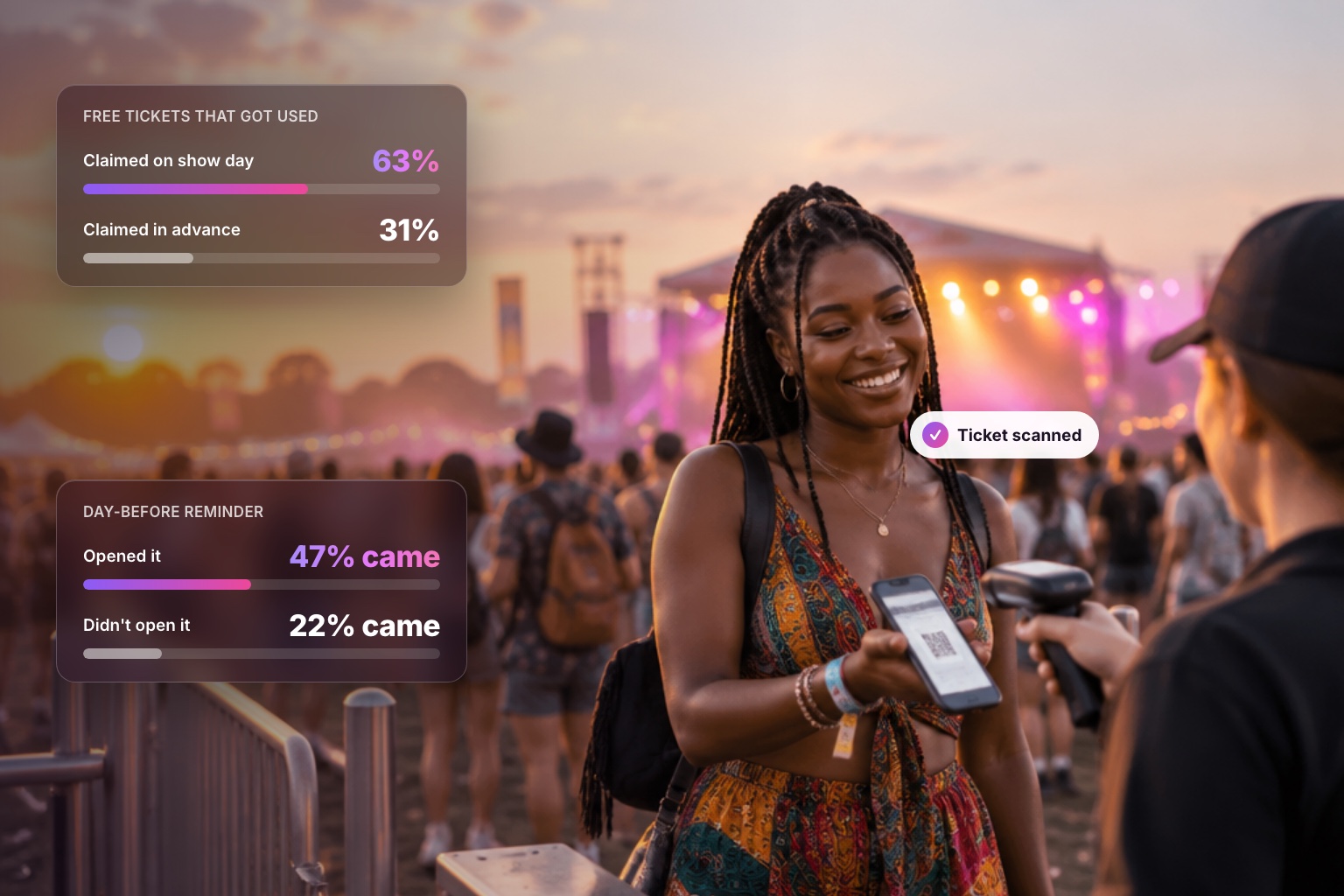
Most people who RSVP to a free event don't come, because a free ticket costs nothing to skip. At a Houston cultural festival in October 2026, only 31% of people who claimed a free ticket in advance were scanned in at the gate. People who claimed one on the day came at 63%. The fixes are simple: plan for the drop-off, remind people three times with their ticket attached, and watch who doesn't open the last reminder. They are your likely no-shows.
How many free RSVPs actually show up?
Fewer than most promoters plan for, and fewer the earlier the ticket was claimed. Here is what we saw for free general admission at one festival of about 2,300 tickets:
| When the free ticket was claimed | Tickets | Came |
|---|---|---|
| July (3+ months out) | 89 | 15% |
| August | 170 | 23% |
| September | 216 | 27% |
| October, before show day | 593 | 37% |
| Show day, before doors | 265 | 63% |
Source: TicketBlox ticket and gate-scan data for one festival, October 2026. "Came" means the ticket was scanned at the gate.
The pattern is clear. A free ticket claimed three months out is a maybe. A free ticket claimed that morning is a plan. Paid events usually lose fewer people, but the same logic applies: the longer the gap between buying and the show, the more life gets in the way.
Why do people skip free events?
- Nothing is at stake. A free RSVP is a bookmark, not a commitment.
- They forget. A ticket claimed in July is buried in an inbox by October.
- Plans change. Weather, work, a better offer, a tired Saturday.
- They can't find the ticket. If getting in means searching their email at the gate, some people don't bother.
How to reduce no-shows at a free event
1. Plan for the real number. If roughly a third of advance free RSVPs come, a 1,000-RSVP list is a crowd of about 300 to 400 plus walk-ups. Staff, order supplies and set capacity on that, not on the RSVP count.
2. Send three reminders, and make the last one the day before. Remind people 7 days, 3 days and 24 hours before the event, with the ticket in the email. The day-before email matters most: it lands just as people decide what they're doing tomorrow.
3. Watch who doesn't open the last reminder. This is the most useful early warning you have. At the festival, people who opened the day-before reminder came at 47%. People who didn't open it came at 22%.
| Reminder | Opened it: came | Didn't open: came |
|---|---|---|
| 7 days before | 41% | 27% |
| 3 days before | 42% | 30% |
| Day before | 47% (174 of 372) | 22% (37 of 172) |
Opening a reminder doesn't make someone come. People who are already planning to come are the ones who open it. That's why it works as a signal: by the night before, this promoter had a list of 172 people, and nearly four in five of them didn't come. Send them a personal text, ask a friend to bring them along, or simply plan for them not being there.
(Some email apps, Apple Mail in particular, load messages automatically and count as "opens". That makes the real gap bigger, not smaller.)
4. Keep registration open on the day. People who claim a ticket on show day are already on their way. At this festival they came at twice the rate of advance RSVPs. Don't close registration early to "protect" the list.
The small stuff matters most
Nobody chooses a ticketing platform because it sends reminder emails. But a 25-point gap in turnout decides whether the room feels full, whether the bar hits its number and whether a sponsor renews.
On TicketBlox, the 7-day, 3-day and 24-hour reminders are scheduled automatically the moment an event is published. They go to every ticket holder, paid or free, with their tickets attached, and they move if the date changes. The promoter in this story never set them up. That's the point: in the busiest week of a show, this is the job that slips, and the platform should do it anyway. Recovering abandoned checkouts is another one of those jobs.
FAQ: Why Most Free Event RSVPs Don't Show Up (and How to Fix It)
What is a normal no-show rate for a free event?
It is often well over half. At one 2026 festival, 31% of advance free RSVPs came, and only 15% of those claimed three months out. Same-day RSVPs came at 63%.
How do I get more people to show up to my free event?
Plan capacity on realistic numbers, send reminders 7 days, 3 days and 24 hours before with the ticket attached, follow up personally with anyone who didn't open the last reminder, and keep registration open on show day.
Do event reminder emails reduce no-shows?
They are strongly linked to attendance. People who opened a day-before reminder came at 47%, against 22% for people who didn't. The biggest value is spotting likely no-shows while there is still time to act.
Should I charge a small fee to stop no-shows?
It can help, because people show up for things they paid for. But it also cuts the number of RSVPs. If the event has to stay free, reminders and same-day registration are the next best tools.
When should I send event reminders?
7 days, 3 days and 24 hours before the event is a good default. In our data, the day-before reminder showed the biggest gap between people who came and people who didn't.