



A buyer adds two GA tickets to their cart. The event page said "$50 all-in." They expect to pay $100 at checkout.
Instead, the total says $103.47.
They didn't misread the price. The platform's math is broken. And the promoter — not the platform — gets the angry DM.
This is happening across the event industry right now. Regulators are pushing for all-in ticket pricing. Platforms are rushing to comply. But most of them are faking it — and the math falls apart the moment a buyer adds a second ticket or mixes ticket types in the same cart.
Here's why it breaks, what the correct approach looks like, and why this matters more than most promoters realize.
The Regulatory Push for All-In Pricing
All-in pricing legislation is gaining momentum globally. The principle is straightforward: the price a buyer sees should be the price they pay. No hidden fees revealed at checkout. No "service charge" surprises. No bait-and-switch.
In the US, the FTC's proposed Junk Fees Rule targets exactly this pattern. The EU's Consumer Rights Directive already requires upfront total pricing. Canada, Australia, and several Latin American markets are moving in the same direction.
For event promoters, this means the era of advertising a $50 ticket and then charging $67.50 at checkout is ending. The industry is being forced to show the real price — and that's a good thing for everyone.
But implementing all-in pricing correctly is harder than it sounds. And most ticketing platforms are getting it wrong in a way that creates more confusion, not less.
The Math Problem Nobody Talks About
Here's the technical reality that most platforms gloss over:
1. Clear Base Pricing First
Ticketing fees are applied per ticket. If your platform charges a 5% service fee, that's 5% of each ticket's base price.
Payment processing fees
Stripe, Adyen, Square) are applied per order — typically a percentage of the total transaction plus a fixed fee (e.g., 2.9% + $0.30).
These two fee structures operate at different levels. Ticketing fees scale linearly with ticket count. Payment processing fees don't — because the fixed component ($0.30) is charged once per order regardless of how many tickets are in the cart.
This means you cannot calculate a mathematically accurate "all-in price per ticket" that stays true when quantities change.
Here's the proof:
| Scenario | Base Price | Ticketing Fee (5%) | Processing (2.9% + $0.30) | True Total | "All-In" Per Ticket |
|---|---|---|---|---|---|
| 1 ticket | $50.00 | $2.50 | $1.82 | $54.32 | $54.32 |
| 2 tickets | $100.00 | $5.00 | $3.35 | $108.35 | $54.18 |
| 4 tickets | $200.00 | $10.00 | $6.40 | $216.40 | $54.10 |
Most platforms ignore this. They calculate the all-in price for one ticket, lock it in, and multiply. The result: the total at checkout doesn't match the math. Buyers feel deceived. Promoters get support tickets. And the "transparency" is actually less honest than the old model of showing fees separately.
That's not compliance. That's approximation dressed up as transparency.
How Other Platforms Handle It (And Why Each Approach Fails)
Approach 1: Fixed "All-In" Price That Doesn't Add Up
The platform calculates an all-in price per ticket for a single-ticket order and displays it as the definitive price. When a buyer adds 2 tickets, the platform multiplies: 2 × $54.32 = $108.64. But the actual processing cost for a 2-ticket order is $108.35. The buyer is overcharged by $0.29.
Multiply this across thousands of orders and you've either overcharged buyers (legal risk) or absorbed the difference yourself (margin erosion). Neither is acceptable.
Approach 2: Absorbing Processing Fees Entirely
Some platforms eat the payment processing fees to make the math "clean." The all-in price is base + ticketing fee, and the platform covers Stripe's cut.
This works until you do the math on volume. At 10,000 tickets sold across 3,000 orders, you're absorbing roughly $900 in fixed processing fees alone. For a platform operating on thin margins, that's a business model problem, not a pricing solution.
Approach 3: Hiding Fees Until Checkout
The oldest trick in the book. Show a clean "$50" price, then reveal $12.50 in fees at checkout. This is exactly what all-in pricing legislation exists to eliminate. Platforms still doing this are on borrowed time.
Approach 4: Showing an Asterisk and Fine Print
"$54.32 all-in*" with a footnote: "*Processing fees may vary based on order size." Technically honest. Practically useless. Buyers don't read footnotes. They read prices.
The Correct Approach: Real-Time Cart-Level Pricing
The right solution acknowledges a simple truth: you can give buyers an honest estimate for a single ticket, but the actual all-in total must be calculated at the cart level in real time.
Here's how TicketBlox handles it:
Step 1: Show the Base Price Clearly
Buyers always see the true base ticket price first. No inflation, no baked-in fees masquerading as the "real" price. The base price is the base price.
Step 2: Display an Honest "All-In Estimate" for Single Tickets
For a single ticket, TicketBlox shows an estimated all-in price that includes ticketing fees and an estimate of payment processing. This gives buyers immediate clarity — with a clear label that processing fees are variable based on order composition.
This is the difference between an honest estimate and a false promise. Buyers understand estimates. They don't forgive lies.
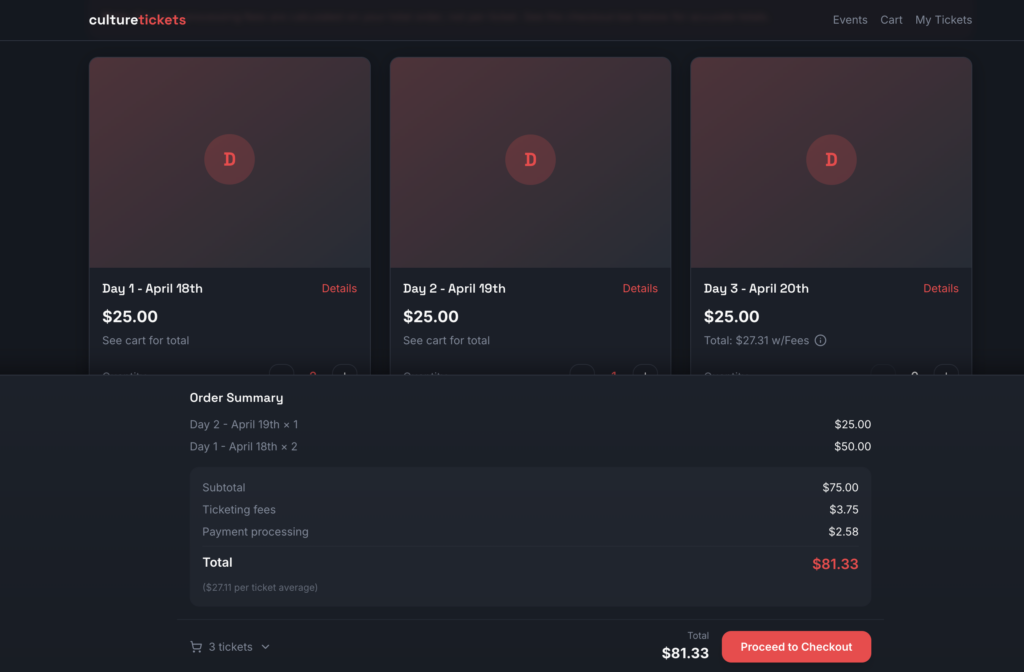
Step 3: Recalculate in Real Time as the Cart Changes
The moment a buyer adds a second ticket, changes quantities, or mixes ticket types, the cart total recalculates live:
- Ticketing fees are computed per ticket
- Payment processing fees are computed once per order, using the actual transaction total
- The displayed total is the real number — not a multiplied guess
A subtle loading indicator signals "we're updating your total" so the buyer understands the system is working, not glitching. Trust is maintained because the behavior is transparent.
Step 4: Offer an Expandable Fee Breakdown
For buyers who want to see exactly where their money goes, an expandable breakdown shows:
- Base ticket subtotal
- Ticketing fees (per ticket)
- Payment processing fees (per order)
- Final total
For buyers who don't care about the breakdown, the total is clean and clear. No one is forced to read a spreadsheet. No one is denied the details if they want them.
This balance — clarity for the casual buyer, transparency for the detail-oriented one — is what actual fee transparency looks like.
Why This Matters for Event Promoters
All-in pricing isn't just a buyer-facing UX decision. It has direct implications for your event economics, partner relationships, and operational overhead.
Fewer Support Tickets and Refund Requests
The number one source of pre-event support tickets is pricing confusion. "Why was I charged $108.64 when the tickets were $50 each?" When your pricing math is accurate and your checkout shows a real-time breakdown, these inquiries drop dramatically.
Fewer support tickets means fewer refunds, fewer chargebacks, and less operational drag — time your team can spend on event day operations instead of explaining fee math.
Consistent Pricing Across Pre-Sale and Box Office
If your event page shows an all-in estimate of $54.32, your Box Office walk-in pricing should be consistent. Buyers who see a friend pay a different price at the door than what they paid online will lose trust instantly. A single pricing engine that handles both channels eliminates this risk.
Clean Revenue Splitting with Partners
When your pricing is transparent and your fee structure is mathematically correct, revenue splitting with partners and affiliates becomes straightforward. Partners can see exactly what the gross revenue is, what the fees are, and what their percentage is calculated against. No disputes over whether fees were inflated. No arguments about base price vs. all-in price calculations.
Higher Buyer Trust = Higher Conversion Rates
Buyers who trust your pricing complete checkout at higher rates. This is measurable. When the price shown on the event page matches (or closely matches) the checkout total, cart abandonment drops.
That trust also carries forward. Buyers who had a clean purchasing experience are more likely to share the event through affiliate links and respond honestly to post-checkout surveys — because they don't feel like they were tricked.
Future-Proofing Against Regulation
All-in pricing legislation is tightening. The promoters and platforms that implement it correctly now won't scramble when new regulations hit. Approximation-based approaches are regulatory liabilities waiting to surface.
How All-In Pricing Connects to Your Platform Decision
When evaluating ticketing platforms, most promoters compare headline features: event page design, payout speed, marketing tools. Pricing transparency is rarely on the comparison checklist — but it should be.
Ask these questions:
- Does the platform calculate the all-in price per ticket or per order? If per ticket, the math breaks at quantity 2. Ask for a demo with a multi-ticket cart.
- What happens when a buyer mixes ticket types? A cart with 2 GA tickets and 1 VIP should show one total with one processing fee, not three separate calculations.
- Can buyers see a fee breakdown? If the platform hides fees or shows a single "all-in" number with no expandable detail, they're betting buyers won't ask. That's not transparency.
- How does the platform handle processing fee variability? Stripe's rates vary by card type (domestic vs. international, credit vs. debit). Does the platform account for this, or does it use a static estimate?
The platforms that get this right are the ones built to be a complete operating system for events — not just a storefront with a payment gateway bolted on.
The Bigger Picture: Transparent Pricing as Competitive Advantage
The event industry is moving toward transparency — not just in pricing, but in how promoters understand their audiences, how they distribute revenue to partners, and how they operate on event day.
Pricing is where that transparency starts. A buyer's first interaction with your event is the price. If that experience is honest, accurate, and easy to understand, you've earned trust before they've walked through the door. If it's confusing, misleading, or "close enough" — you've created friction that compounds through every subsequent interaction.
All-in pricing done right isn't a compliance burden. It's a conversion advantage, a partner trust builder, and a signal that your event business operates with precision.
TicketBlox was built to handle the math correctly — not approximately. Real-time cart-level recalculation. Honest estimates. Expandable breakdowns. Zero deception.
Book a Demo → and see how all-in pricing actually works when the math is right.
Frequently Asked Questions
What is all-in ticket pricing?
All-in ticket pricing means the price displayed to the buyer includes all fees — ticketing service fees, payment processing fees, and any other charges. The goal is to eliminate surprise fees at checkout. Regulations like the FTC's Junk Fees Rule and the EU's Consumer Rights Directive are pushing the event industry toward mandatory all-in pricing.
Why do ticket fees change when I add more tickets to my cart?
Payment processing fees (charged by Stripe, Adyen, etc.) include a fixed per-transaction component — typically $0.30 per order. This fixed fee is charged once regardless of how many tickets are in the order. When you add more tickets, that $0.30 is spread across more items, slightly reducing the effective per-ticket fee. Platforms that show a fixed "all-in price per ticket" are hiding this math.
How do I know if my ticketing platform is calculating all-in pricing correctly?
Test it: add one ticket to the cart and note the total. Then add two tickets and divide by two. If the per-ticket price is exactly the same, the platform is likely multiplying a fixed estimate rather than calculating the real processing fee per order. Correct all-in pricing will show a slightly lower per-ticket cost at higher quantities because the fixed processing fee is amortized.
Can event promoters pass payment processing fees to buyers?
In most jurisdictions, yes — as long as the fees are disclosed clearly and the total price is displayed before the buyer commits to purchase. The key is transparency: buyers should understand what they're paying and why. All-in pricing that includes processing fees and displays them in an expandable breakdown satisfies both legal requirements and buyer expectations.
What's the difference between "absorbed" fees and "passed-through" fees?
When fees are absorbed, the promoter pays the processing costs out of their ticket revenue — the buyer sees only the base price. When fees are passed through, the buyer's total includes the processing costs — clearly labeled. Absorbing fees makes pricing simpler but reduces promoter margins. Passing fees through with transparent labeling maintains margins while keeping buyer trust intact.
Does all-in pricing affect event sponsorship and partner revenue calculations?
Yes. When your pricing is transparent and mathematically accurate, partners and sponsors can see exactly what the gross revenue is before fees. This makes revenue splitting cleaner — partner percentages are calculated on verifiable numbers, not estimates. Opaque pricing creates disputes; transparent pricing builds trust.