


You spent $30,000 on an event sponsorship. The post-event report lands in your inbox: 14,000 estimated logo impressions, 500 booth visitors, and a few photos of your banner next to the main stage.
Now try presenting that to your CFO.
The conversation usually goes something like this: "So we spent $30K and... people might have seen our logo?" That is the moment most sponsorship budgets get slashed. Not because events fail to deliver value, but because the metrics used to prove that value are stuck in 2010.
Estimated impressions are not a business outcome. Foot traffic counts are not pipeline. And a logo on a lanyard does not generate revenue you can trace.
The good news: the measurement problem is solvable. Digital activations such as sweepstakes entries, surveys, sponsored upgrades, and QR-triggered experiences turn every interaction into a data point. Every giveaway entry is a captured lead. Every survey response is market research. Every sponsored upgrade is attributed revenue.
This article breaks down the five metrics that actually survive a finance review, how to track each one, and why event sponsorship with digital activations consistently outperforms digital ads on engagement depth.
Why Traditional Sponsorship Metrics Fail the CFO Test
Traditional event sponsorship reporting relies on three pillars, all of which are shaky.
Estimated impressions. These are calculated by multiplying attendance by an assumed visibility rate. The formula is inherently speculative. Did 14,000 people see your logo, or did 14,000 people attend an event where your logo existed somewhere in the venue? There is a significant difference.
Foot traffic. Booth visitor counts, even when captured by clicker counters or heat maps, tell you who walked past, not who engaged, not who converted, and not who remembered your brand 48 hours later.
Social media mentions. Organic mentions are nice. They are also inconsistent, hard to attribute, and impossible to tie to pipeline without additional tracking.
These metrics share a fatal flaw: they measure proximity, not action. A CFO needs to see cost-per-outcome, not cost-per-maybe.
The shift is straightforward. Instead of measuring how many people were near your brand, measure how many people did something with it. That requires digital activations embedded into the sponsorship itself.
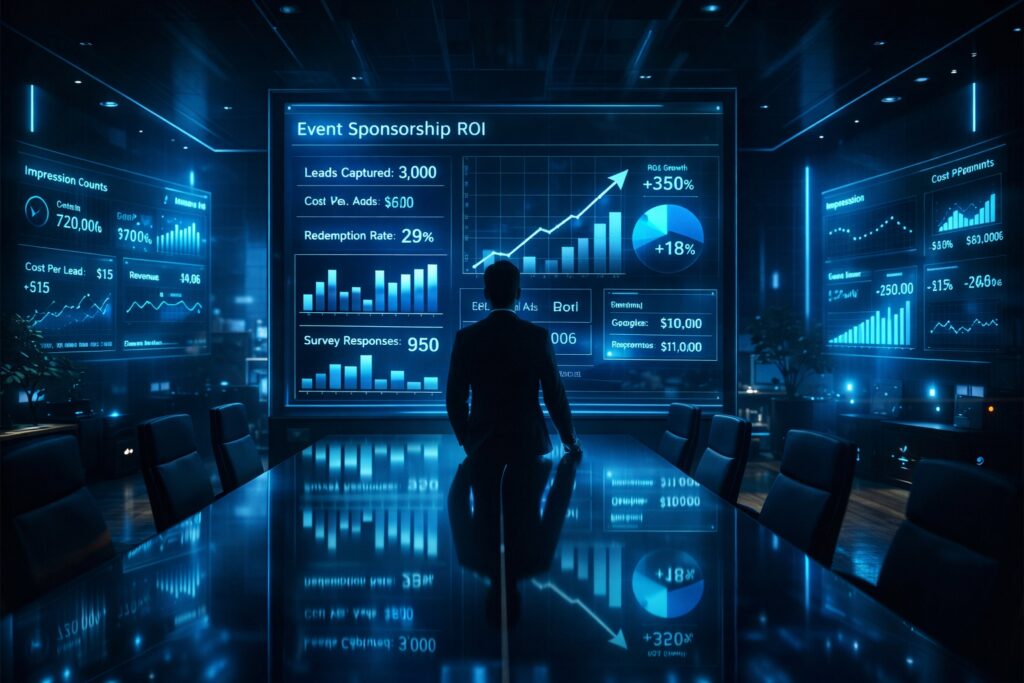
The 5 Event Sponsorship ROI Metrics That Actually Matter
1. Leads Captured
This is the foundation. Every sponsorship should generate a list of named, contactable people who opted in through a branded interaction.
How it works: A sweepstakes or giveaway tied to your sponsorship requires attendees to enter their name, email, and phone number. The entry form can include consent checkboxes for follow-up marketing. The result is a permission-based lead list generated in real time during the event.
How to track it: Use a platform that captures entries digitally and syncs them to your CRM automatically. TicketBlox's sweepstakes tools do exactly this. Every entry flows directly into Boomerang CRM, giving you a segmented lead list before the event is over.
What to report: Total leads captured, cost-per-lead (sponsorship spend divided by leads), and lead quality indicators like survey completeness or repeat engagement.
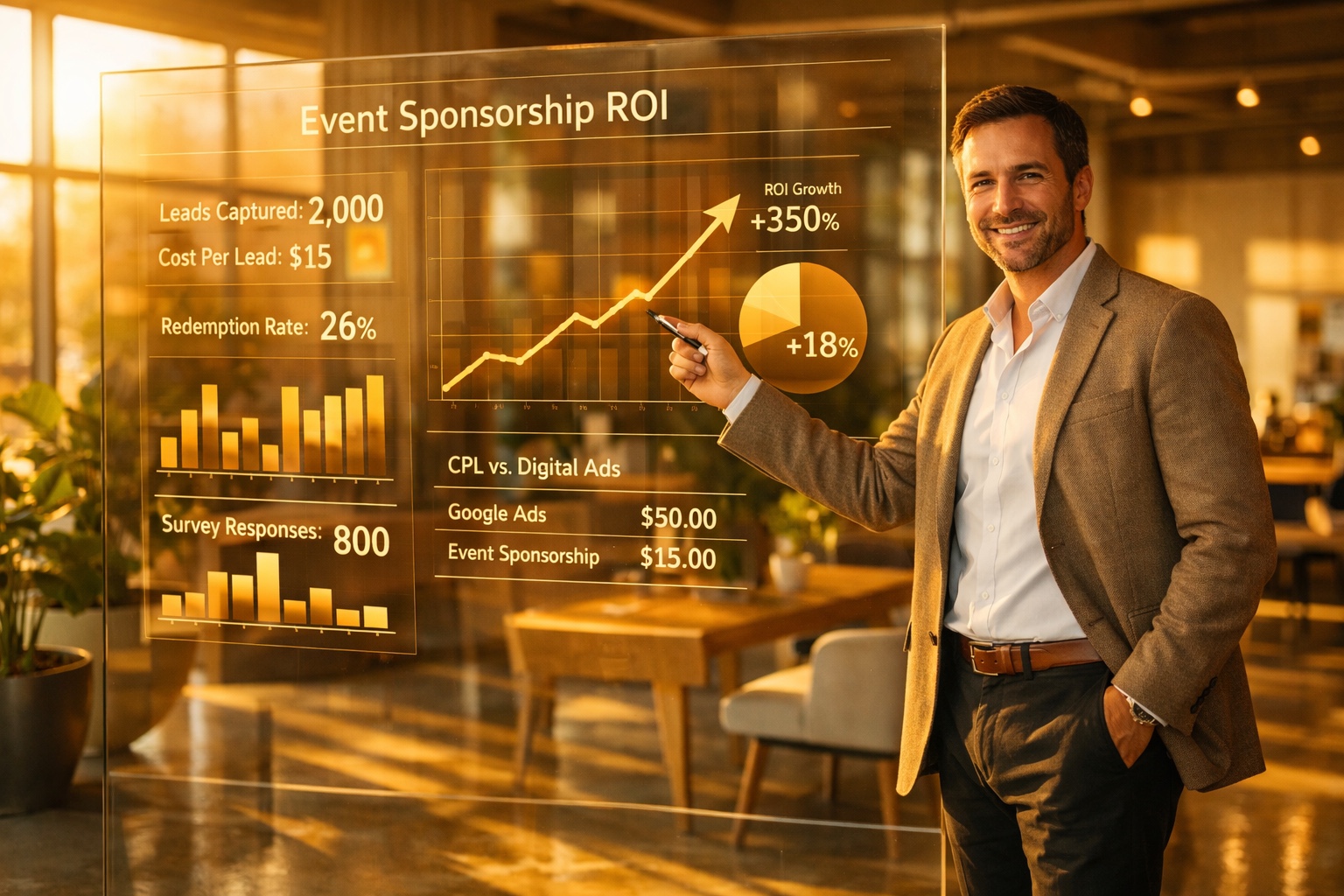
A $30,000 sponsorship that captures 2,000 qualified leads puts your cost-per-lead at $15. Compare that to your digital ad CPA and the conversation with finance changes immediately.
2. Survey Responses (Market Research Value)
Most brands pay research firms five figures for consumer insights. Event sponsorships can generate the same data as a byproduct.
How it works: Embed a short survey (3-5 questions) into your activation. This could be part of a sweepstakes entry, a standalone QR code experience, or a post-interaction follow-up. Questions should focus on purchase intent, brand perception, product preferences, or competitive positioning.
How to track it: Digital survey tools attached to your sponsorship activation capture responses with timestamps, demographic context, and event-specific segmentation. TicketBlox's built-in survey tools let sponsors collect structured responses at checkout, during the event, and post-event, all tied to individual attendee profiles.
What to report: Total responses, response rate (responses divided by activation participants), and the dollar value of equivalent market research. If a research firm would charge $20,000 for 500 consumer surveys in your target demographic, and your sponsorship generated 800 responses, that is quantifiable value.
3. Redemption Rate
Redemption rate measures the percentage of people who received a sponsored offer and actually used it. This is the metric that separates passive awareness from active engagement.
How it works: Offer something trackable through your sponsorship such as a discount code, a free sample redemption, a sponsored experience upgrade, or a digital voucher. The key is that each redemption requires a measurable action: scanning a code, clicking a link, or completing a transaction.
How to track it: Issue unique codes or trackable links tied to your sponsorship. Monitor redemption in real time. If you distributed 5,000 sponsored drink vouchers via QR code and 1,200 were redeemed, your redemption rate is 24%.
What to report: Offers distributed, offers redeemed, redemption rate, and revenue generated from redeemed offers. A 20-30% redemption rate at events is strong. For context, email marketing averages a 1-2% click-through rate. Events compress the decision cycle because the audience is already engaged and present.
4. Brand Lift
Brand lift measures whether your sponsorship changed how people perceive your brand. This is the metric that justifies long-term sponsorship commitments, not just one-off activations.
How it works: Run a short brand perception survey before or at the start of the event (baseline) and a follow-up survey 48-72 hours after the event. Compare the results. Key questions include aided and unaided brand recall, purchase consideration, brand favorability, and net promoter likelihood.
How to track it: Pre-event surveys can be embedded into the ticket purchase or confirmation flow. Post-event surveys go out via email or SMS to attendees who interacted with your activation. The delta between pre and post is your brand lift.
What to report: Percentage change in aided recall, favorability score shift, and purchase intent change. A 15-point increase in aided brand recall among event attendees versus a control group is a defensible data point in any budget meeting.
Platforms like TicketBlox that handle both the ticketing and the post-event communication make this measurement loop seamless. The same system that sold the ticket sends the follow-up survey and ties it back to the attendee profile.
5. Cost-Per-Lead vs. Digital Ad CPA
This is the metric that wins the budget argument. It reframes sponsorship spend in the same language your CFO already uses to evaluate paid media.
How it works: Calculate your event sponsorship cost-per-lead (total spend divided by leads captured) and compare it directly to your digital advertising cost-per-acquisition across channels like Google Ads, Meta, and LinkedIn.
How to track it: Pull your digital ad CPA from your ad platforms. Pull your event sponsorship CPL from your activation data. Place them side by side.
What to report: Here is a sample comparison table:
| Channel | Spend | Leads | Cost Per Lead |
|---|---|---|---|
| Google Ads | $30,000 | 600 | $50.00 |
| Meta Ads | $30,000 | 1,000 | $30.00 |
| LinkedIn Ads | $30,000 | 300 | $100.00 |
| Event Sponsorship (with digital activation) | $30,000 | 2,000 | $15.00 |
The numbers shift by industry, but the pattern holds. Event sponsorships with digital activations routinely deliver lower cost-per-lead than paid digital channels. And the leads are warmer. These are people who physically showed up, engaged with your brand in person, and opted in voluntarily.
Why Event Sponsorships Outperform Digital Ads on Engagement Depth

Cost-per-lead tells part of the story. Engagement depth tells the rest.
A digital ad gets a click. An event activation gets five minutes of undivided attention, a face-to-face interaction, and an emotional association with a live experience. Research consistently shows that live events generate outsized economic and psychological engagement compared to digital-only touchpoints.
Consider the difference in data richness:
- Digital ad lead: Name, email, maybe a phone number. You know they clicked.
- Event activation lead: Name, email, phone number, survey responses about preferences and purchase intent, behavioral data on what they redeemed, and context about the event they attended.
That second profile is dramatically more useful for sales follow-up and segmentation. It is also more expensive to replicate through digital channels alone.
The engagement depth advantage compounds over time. Leads captured through in-person activations convert at higher rates because the brand interaction was experiential, not transactional. They remember the moment, not just the message.
How to Build a Sponsorship Report Your CFO Will Actually Read
Stop sending 20-page decks full of photos and estimated impressions. Build a one-page sponsorship performance summary with these sections.
Section 1: Investment Summary. Total sponsorship spend, activation costs, and staffing costs. One number: total invested.
Section 2: Lead Generation. Leads captured, cost-per-lead, comparison to digital ad CPA. Show the table.
Section 3: Market Research Value. Survey responses collected, equivalent research cost, and top three insights.
Section 4: Engagement Metrics. Redemption rate, activation participation rate, average time engaged.
Section 5: Brand Impact. Brand lift data if available, social amplification metrics, and qualitative highlights.
Section 6: Recommendation. Based on the data, should you renew, expand, or reallocate? Let the numbers make the argument.
The key is framing sponsorship in the same performance language used for every other marketing channel. When you present event sponsorship ROI measurement alongside your paid media dashboard, it stops being a "nice-to-have" and starts being a performance channel.
Setting Up Digital Activations Before the Event
None of these metrics are trackable without the right infrastructure in place before the event starts. Here is the pre-event checklist.
60 days out: Confirm what digital activations your sponsorship will include. Negotiate for sweepstakes rights, survey placement, and branded digital experiences. If the event organizer uses a platform like TicketBlox, these tools are built in. You should ask for access.
30 days out: Design your activation flow. Map every touchpoint where data gets captured: entry forms, survey questions, redemption codes, follow-up triggers. Define your lead qualification criteria.
14 days out: Test every link, form, and QR code. Confirm CRM integration is live. Set up your baseline brand lift survey if applicable. Choosing an event platform that centralizes these tools reduces the integration risk significantly.
Day of event: Monitor activation data in real time. If lead capture is underperforming, adjust your booth flow or incentive. Real-time analytics, like those available through TicketBlox Sense, let you course-correct during the event, not after.
48 hours post-event: Launch post-event surveys and follow-up sequences. The window for attendee engagement closes fast. Automate this through your CRM so it fires without manual intervention.
Frequently Asked Questions
What is a good cost-per-lead for event sponsorships?
It varies by industry, but $10-$25 per lead is a strong benchmark for event sponsorships with digital activations. Compare this to B2B digital ad CPAs that often range from $50-$150. The important thing is to track and benchmark your own numbers event over event, then compare directly to your other marketing channels.
How do I track leads from an event sponsorship if the organizer controls the platform?
Ask the event organizer what data you will receive before signing the sponsorship agreement. The best arrangement gives you direct access to leads captured through your branded activation. Platforms like TicketBlox allow organizers to share segmented lead data with sponsors through Boomerang CRM, so both parties have visibility without compromising attendee privacy.
Can I measure event sponsorship ROI for brand awareness campaigns that are not focused on lead generation?
Yes. Brand lift studies are the standard approach. Pair them with social listening data and direct traffic spikes during and after the event. The key is establishing a baseline before the event so you have something to measure against.
How many survey questions should I include in an event activation?
Keep it to 3-5 questions. Completion rates drop sharply after five questions in a live event setting. Focus on high-value questions: purchase intent, brand preference, and one or two questions specific to your product category. Every response is usable market research, so quality of questions matters more than quantity.
What is the minimum sponsorship budget where digital activation tracking makes sense?
There is no hard minimum, but the ROI case becomes straightforward at $5,000 and above. Below that, the activation setup cost may not justify the measurement infrastructure. That said, if the event platform already supports digital activations natively, the marginal cost of tracking is close to zero. That is one reason choosing the right event technology partner matters.
Ready to turn your next event sponsorship into a trackable performance channel? TicketBlox gives sponsors and organizers the digital activation tools such as sweepstakes, surveys, real-time analytics, and CRM integration to measure every interaction and prove ROI with real numbers.