


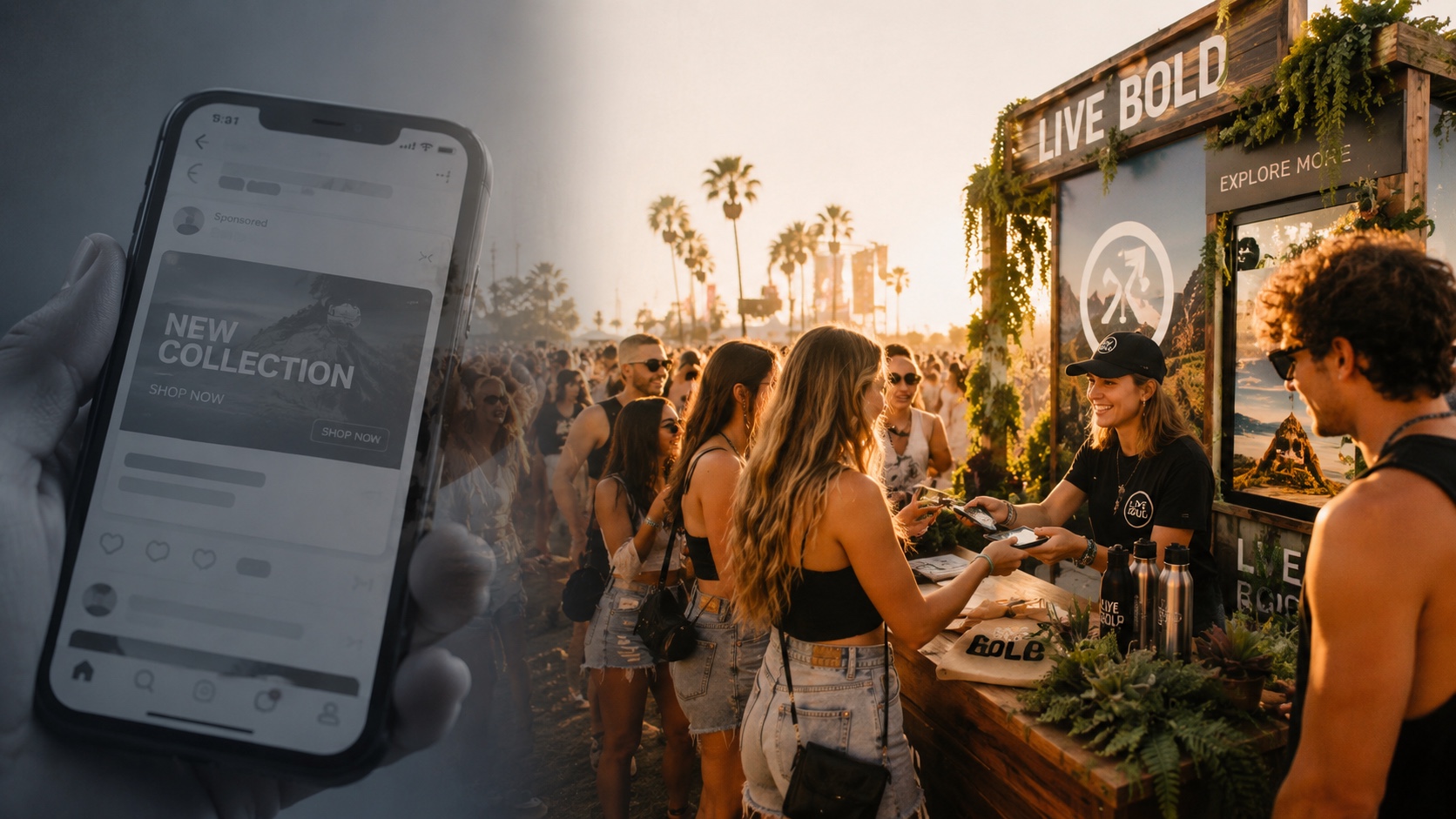
What is the difference between event sponsorship and digital advertising?
Event sponsorship creates deeper audience engagement and generates first-party data through live experiences, while digital advertising focuses on scalable reach through paid online channels. Brands are increasingly shifting budget toward digitally activated sponsorships because they deliver stronger engagement, owned audience data, and competitive cost-per-lead performance.
Your digital ad costs are climbing. Your click-through rates are falling. And your CFO wants to know why the last campaign delivered a 0.06% CTR on display ads while costing 30% more than it did three years ago.
You are not alone.
Across industries, CMOs are reevaluating their channel allocations and asking a question that would have sounded backward five years ago:
Should we invest more in event sponsorship?
The answer is increasingly yes — especially when sponsorship is measurable, digitally activated, and integrated into a first-party data strategy.
Why Digital Advertising Is Becoming Less Efficient
Digital advertising was supposed to be the measurable marketing channel. The accountable one. The system where every dollar could be tied directly to an outcome.
That promise is weakening.
Digital ad costs continue to rise
Meta CPMs now average around $6.59, with Instagram surpassing $9.46 during peak periods. Snapchat CPMs increased 47% year over year in 2024. TikTok CPMs rose another 8% after a 19% jump the year before.
Across Tier 1 markets, digital advertising costs increased roughly 12% year over year through late 2025 due to:
- Retail media saturation
- Increased competition for inventory
- Platform algorithm shifts
- Audience fragmentation
Engagement rates continue to decline
The average display ad CTR remains between 0.05% and 0.1%.
Meanwhile:
- Banner blindness affects more than 86% of internet users
- Most ads receive milliseconds of attention
- Social feeds are increasingly saturated
- Attention spans continue shrinking
Even strong-performing video campaigns still compete in environments where users scroll through hundreds of feet of content every day.
Third-party cookies are disappearing
Safari and Firefox already block third-party cookies by default. Google has repeatedly shifted its cookie deprecation strategy, but the broader direction remains clear:
The future of marketing belongs to first-party data.
A March 2025 Digiday report found that over 70% of marketers feel underprepared for the future of cookie-based advertising.
That means many brands are now paying more to reach audiences with:
- Less reliable targeting
- Lower engagement
- Reduced data visibility
- Increasing platform dependency
Why Brands Are Returning to Event Sponsorship
Event sponsorship used to be considered difficult to measure.
That perception is outdated.
Modern sponsorship programs combine physical experiences with digital engagement layers that make attribution, lead capture, and ROI measurement significantly easier.
According to IEG research:
- Sponsorships can drive a 10–15% lift in unaided brand awareness
- Focused activations outperform broad sponsorship portfolios
- Experience-driven engagement creates stronger memory retention
Most importantly, events create something digital advertising cannot replicate:
An emotionally engaged audience choosing to interact with your brand in real life.
Someone standing at your activation booth for five minutes is fundamentally different from someone scrolling past a banner ad in half a second.
That engagement depth changes everything.
Event Sponsorship vs Digital Advertising: Key Differences
| Dimension | Digital Advertising | Event Sponsorship |
|---|---|---|
| Engagement | Seconds of attention | Minutes of interaction |
| Data Ownership | Platform-controlled | First-party brand-owned |
| Audience Intent | Broad targeting | Self-selected participation |
| Cookie Dependency | High | None |
| Brand Recall | Lower | Higher emotional retention |
| Lead Quality | Variable | Context-rich and engaged |
| Relationship Building | Limited | Stronger long-term connection |
Why First-Party Data Matters More Than Ever
The biggest advantage of event sponsorship is not impressions.
It is ownership.
Brands increasingly realize that first-party audience data is one of the most valuable long-term marketing assets they can build.
When attendees engage with a branded activation using:
- QR codes
- Surveys
- Sweepstakes
- Gamified experiences
- Exclusive content unlocks
…they willingly provide valuable first-party information.
That data can include:
- Contact details
- Purchase intent
- Product preferences
- Behavioral signals
- Geographic segmentation
- Event affinity
Unlike cookie-based data, this information:
- Does not expire
- Does not depend on browser policies
- Is fully owned by the brand
- Can be activated across every marketing channel
Brands using digitally activated sponsorships are effectively building proprietary audience ecosystems.
For example, a brand running ten large-scale activations per year could collect tens of thousands of qualified leads that can later power:
- CRM segmentation
- Email campaigns
- Retargeting
- Loyalty programs
- Lookalike audience creation
- Customer intelligence initiatives
This is why modern event activations increasingly focus on interactive engagement experiences like sweepstakes activations rather than passive logo placement.
Why Most Event Sponsorships Still Fail
Despite the advantages, many sponsorships still underperform.
The reason is simple:
Most brands still do not measure them correctly.
An ANA/IEG survey found that 65% of sponsors fail to properly measure sponsorship outcomes.
That typically happens because brands rely on:
- Logo visibility alone
- Vanity metrics
- Delayed reporting
- Manual spreadsheets
- Disconnected lead capture systems
Without digital infrastructure, sponsorship becomes difficult to justify financially.
How to Make Event Sponsorship Measurable
Modern sponsorship measurement requires three core components.
1. Digital activation
Every sponsorship should include interactive engagement mechanisms such as:
- QR code experiences
- Sweepstakes
- Surveys
- Gamification
- Exclusive digital content
- Lead capture forms
Without engagement capture, sponsorship loses most of its measurable value.
2. Real-time analytics
Sponsors should be able to track:
- Activation engagement
- Dwell time
- Lead capture volume
- Survey completion
- Audience interaction patterns
…while the event is still happening.
3. CRM integration
Event data should flow directly into the marketing stack.
That allows brands to transform event engagement into long-term audience intelligence instead of isolated campaign activity.
This is where platforms focused on event audience data collection become strategically important.
How TicketBlox Makes Sponsorship Measurable
TicketBlox helps brands transform sponsorship into a performance-driven marketing channel.
Sense Analytics
Sense Analytics provides real-time sponsorship measurement by tracking:
- Engagement volume
- Activation interactions
- Dwell time
- Audience participation
- Sponsor performance metrics
This allows sponsorship ROI to be compared directly against digital advertising performance.
Sweepstakes
Sweepstakes convert passive attendees into active participants.
Instead of simply displaying a logo, brands can create incentive-driven activations that generate qualified first-party leads at scale.
Surveys
Embedded surveys help brands collect:
- Brand perception data
- Purchase intent insights
- Product feedback
- Audience segmentation information
This turns events into live consumer research environments.
CRM (Boomerang!)
Boomerang! centralizes all captured audience data into a first-party CRM ecosystem fully owned by the brand.
That means:
- No cookie dependency
- No third-party platform risk
- No audience loss due to policy changes
Events are no longer just entertainment experiences.
They are increasingly becoming multi-layered economies where brands, promoters, and audiences exchange measurable value.
The Best Strategy Is Not Either/Or
The strongest marketing strategies do not choose between event sponsorship and digital advertising.
They combine both.
Digital ads work best for:
- Broad reach
- Fast scaling
- Direct-response campaigns
- Top-of-funnel awareness
Event sponsorship works best for:
- Emotional engagement
- Audience development
- First-party data collection
- Long-term brand affinity
- Community building
The brands gaining market share are integrating the two systems together:
- Capture first-party data at events
- Feed that data into CRM
- Build audience segments
- Improve digital targeting using real engagement behavior
That creates a compounding marketing flywheel.
If you are evaluating event ticketing and activation platforms, the most important consideration is not just ticketing functionality.
It is audience ownership.
FAQ
Is event sponsorship more effective than digital advertising?
Event sponsorship often delivers stronger engagement and better first-party data collection than digital advertising. While digital ads scale more efficiently for impressions, event sponsorship creates deeper audience relationships and higher-quality engagement.
Why are brands shifting budget back to sponsorships?
Brands are shifting budget toward sponsorship because digital ad costs continue rising while engagement decreases. Sponsorship also provides first-party audience data that brands fully own.
How do brands measure event sponsorship ROI?
Brands measure sponsorship ROI using real-time analytics, lead capture systems, surveys, CRM integration, engagement tracking, and activation performance metrics.
What makes event sponsorship different from display ads?
Display ads compete for seconds of attention inside crowded feeds. Event sponsorship creates immersive, real-world engagement where attendees voluntarily interact with brands for minutes at a time.
Why is first-party data from events valuable?
First-party event data is permission-based, fully owned by the brand, and independent of third-party cookies or platform policies. It can improve CRM segmentation, audience targeting, and long-term marketing efficiency.
Ready to Make Sponsorship Measurable?
Book a Demo to see how TicketBlox Sense Analytics, Sweepstakes, Surveys, and CRM transform sponsorship into a measurable performance channel.