


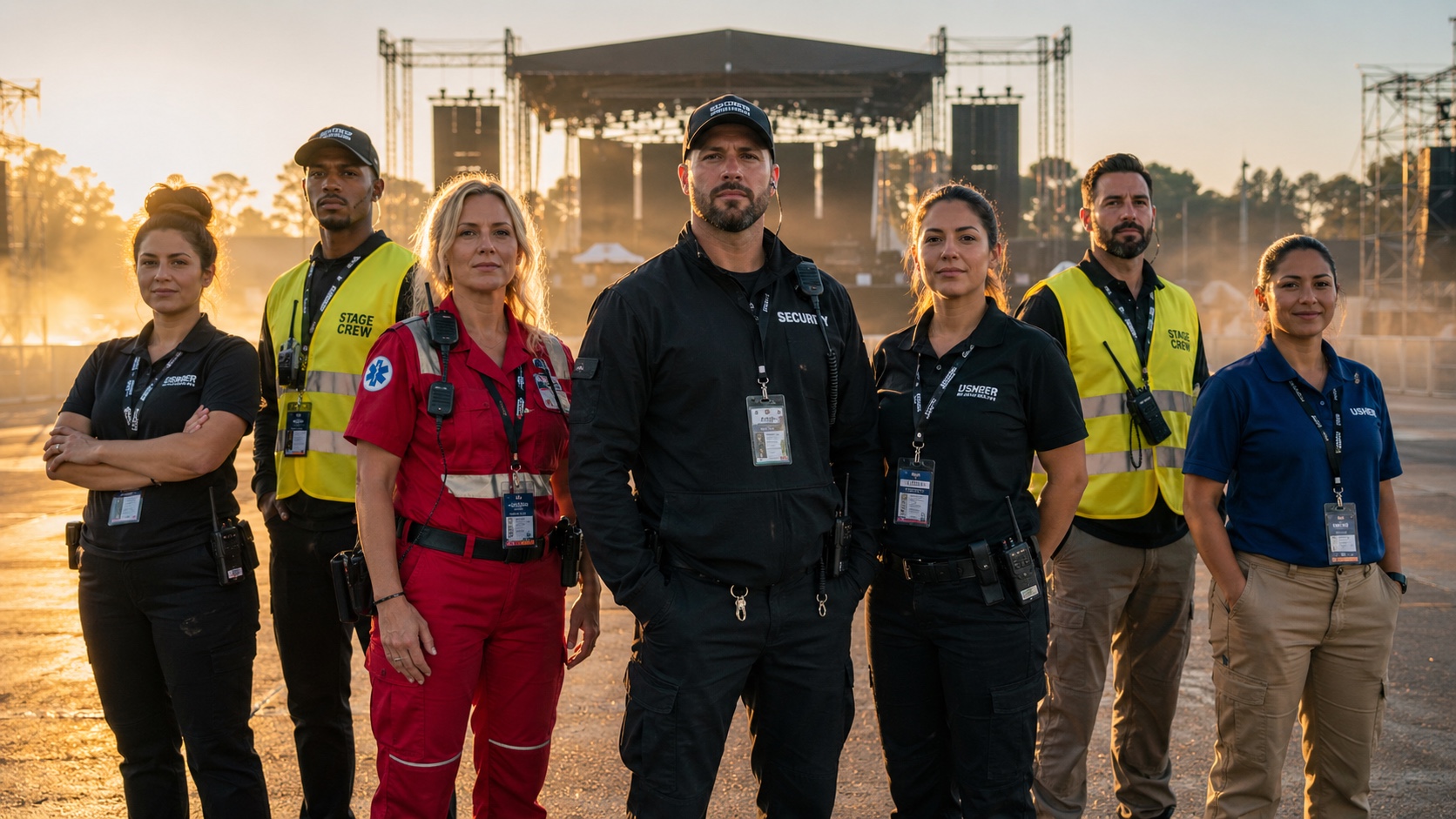
Event staffing is determined by throughput, expected attendance, and operational efficiency — not venue capacity or guesswork.
You are three days out from your event. You have a venue, a lineup, and tickets moving. But one question keeps nagging: how many staff do you actually need?
Overstaff and you burn through your margin. Understaff and you get long lines, security gaps, and angry attendees who torch you on social media before the headliner even hits the stage.
This event staffing guide gives you concrete formulas, role-by-role breakdowns, and a staffing calculator you can use right now. We will also show you where technology legitimately cuts headcount without cutting corners.
The Six Roles You Need to Staff
Every event requires six core staffing roles: gate, Box Office, security, support, production, and food service.
Before we get into numbers, let's define the roles. Every event, regardless of size, needs coverage across these six categories.
1. Gate and Scanning Staff
Gate staff control throughput — the speed at which attendees enter your event.
These are your front line. They scan tickets, verify IDs (if age-restricted), manage wristbands, and control the flow of people into the venue. The speed of your gate staff determines how long your attendees wait in line, and that first impression sets the tone for the entire event.
2. Box Office Staff
Box Office staff handle all on-site ticket issues and walk-up transactions.
Walk-ups still happen. Ticket issues still happen. Someone bought tickets under their ex's email and now can't find the confirmation. Box Office staff handle on-site sales, ticket lookups, will-call pickups, and upgrades.
3. Security
Security staffing is typically calculated using a 1:100–150 attendee ratio.
Non-negotiable. Security handles bag checks, crowd management, conflict resolution, medical emergencies, and perimeter control. Local regulations often dictate minimum ratios.
4. Customer Support
Customer support absorbs pre-event and real-time attendee issues across channels.
Phone calls, emails, and DMs spike in the 48 hours before an event and don't stop until the doors close. Someone can't download their ticket. Someone wants a refund. Someone needs accessibility accommodations. This volume has to go somewhere.
5. Production and Stage Crew
Production staff ensure the technical execution of your event.
Sound engineers, lighting techs, stage managers, and AV operators. These are usually specialized hires or provided by the venue, but you still need to account for them in your staffing plan and budget.
6. Bar and Food Service
Food and beverage staffing often represents the largest on-site workforce.
If your event serves food or drinks, these staff often outnumber every other category combined. We will include baseline numbers, but food and beverage staffing is its own discipline.
Staffing Formulas by Event Size
Event staffing scales with attendance, entry complexity, and service demand.
Here is where it gets specific. These formulas are based on industry standards, adjusted for modern scanning technology and operational tools.
How many staff do you need for a 500-person event?
A typical indoor venue with one or two entry points.
Gate/Scanning: 2
Box Office: 1
Security: 3–4
Customer Support: 1–2
Production/Stage: 2–3
Bar Staff: 3–4
Total staff: 12–16 people
How many staff do you need for a 2,000-person event?
A mid-size venue or outdoor space with multiple entry lanes.
Gate/Scanning: 4–6
Box Office: 2–3
Security: 12–16
Customer Support: 3–4
Production/Stage: 4–6
Bar/Food: 8–12
Total staff: 33–47 people
How many staff do you need for a 5,000-person festival?
Multi-stage outdoor event running a full day or weekend.
Gate/Scanning: 8–12
Box Office: 4–5
Security: 35–40
Customer Support: 5–6
Production/Stage: 10–15
Bar/Food: 25–35
Total staff: 87–113 people
How many staff do you need for a 10,000+ event?
Large-scale festival, stadium show, or multi-day event.
Gate/Scanning: 15–25
Box Office: 6–8
Security: 70–80+
Customer Support: 8–10
Production/Stage: 20–30
Bar/Food: 50–80
Operations/Coordinators: 5–8
Total staff: 174–241 people
The Staffing Calculator: Gate Staff Math
Gate staffing is calculated using throughput per hour, not total attendance.
Throughput per gate = (3,600 seconds per hour) / (scan time in seconds + handling time in seconds)
How do you calculate gate staffing?
Divide expected attendance by your arrival window to get peak hourly demand. Then divide that by throughput per scanner.
With traditional scanning (2–3 seconds scan time + 5 seconds handling), one gate processes roughly 450–500 people per hour. With sub-10ms scanning technology, the scan itself becomes negligible and handling time is the only bottleneck, pushing throughput to 600–720 people per hour.
How Technology Reduces Staffing Needs
Technology reduces staffing by increasing efficiency at operational bottlenecks.
Faster Scanning Means Fewer Gate Staff
Faster scanning increases throughput, reducing required staff.
When your scanning app processes tickets in under 10 milliseconds, the scan itself is essentially instant.
Self-Service Box Office Eliminates Window Staff
Self-service reduces the need for staffed Box Office windows.
Self-service kiosks allow attendees to resolve issues without staff intervention.
AI Customer Support Absorbs Volume
AI can handle 70–80% of support inquiries automatically.
AI support agents reduce the need for dedicated support teams.
Real-Time Dashboards Replace Coordinator Layers
Centralized dashboards reduce operational overhead.
When you have a single real-time dashboard showing operations data, you eliminate layers of coordination.
The Cost Math
Staffing is the largest variable cost on event day.
Staffing costs typically range from $15–25 per hour.
Per-Event Savings
Reducing just 3–4 staff members can save $270–$600 per event.
Annual Savings at Scale
At 30–50 events per year, that translates to $15,000–$30,000 in savings.
These savings can be distributed across multiple stakeholders automatically.
Building Your Staffing Plan: Step by Step
A proper staffing plan starts with attendance and is refined through data and tools.
How do you build an event staffing plan?
Step 1: Start with expected attendance
Step 2: Apply role ratios
Step 3: Adjust based on tech
Step 4: Map timeline
Step 5: Add 10–15% buffer
If needed, compare ticketing platforms based on operational capabilities.
Common Staffing Mistakes
Most staffing issues come from miscalculating demand or ignoring operational dynamics.
- Staffing for capacity instead of attendance
- Ignoring arrival peaks
- No floating staff
- No customer support
- Not accounting for breaks
FAQ
How many security guards do I need?
1 per 100–150 attendees.
How do I calculate gate staff?
Use throughput formula based on arrival window.
Can technology replace staff?
It reduces headcount, not eliminates roles.
What is the biggest staffing cost?
Security, followed by food & beverage.
How far in advance should I hire?
2–8 weeks depending on role.
Staff your next event with the right numbers, not guesses.
TicketBlox gives you sub-10ms scanning, AI support, self-service Box Office, and real-time dashboards so you can run leaner.
👉 Book a Demo and see how much you can save on your next event.