



Organising an event means wearing many hats – promoter, marketer, finance manager and on‑the‑day fire‑fighter.
When you’re working with a limited budget, fees from ticketing platforms can easily erode profits.
“Free Event Ticketing Platforms” is therefore the most‑searched term in ticketing – but as any experienced organizer knows, free isn’t always free.
Some platforms wave subscription fees but charge high per‑ticket commissions or withhold your revenue for weeks.
This guide compares ten of the most popular free‑tier ticketing platforms for 2026, explains what “free” actually means, and highlights where each solution shines.
What “free” really means in event ticketing
According to EventCube's 2026 analysis, “free” often refers to the absence of a monthly subscription.
However, many platforms still charge a percentage of each ticket sold or levy transaction fees that are passed on to buyers.
In some cases, only free events qualify for zero fees. When evaluating “free” platforms you should consider:
- Fee structure: Does the platform charge per ticket (flat fee or percentage), monthly subscription or payment‑processing fees? Can you pass those fees onto attendees?
- Payouts: How quickly do you receive your money? Some services hold funds until after the event, while others pay out within days or instantly.
- Feature depth: Free tiers sometimes restrict access to advanced tools (e.g. custom branding, CRM, marketing automation, seating charts).
- Brand control & data ownership: Can you white‑label your ticket page? Do you retain attendee data or does the platform control it?
- Scaling: Are there limits on attendee numbers or events? Is the platform built for small gatherings, large festivals or both?
With those criteria in mind, here’s how the leading platforms stack up in 2026.
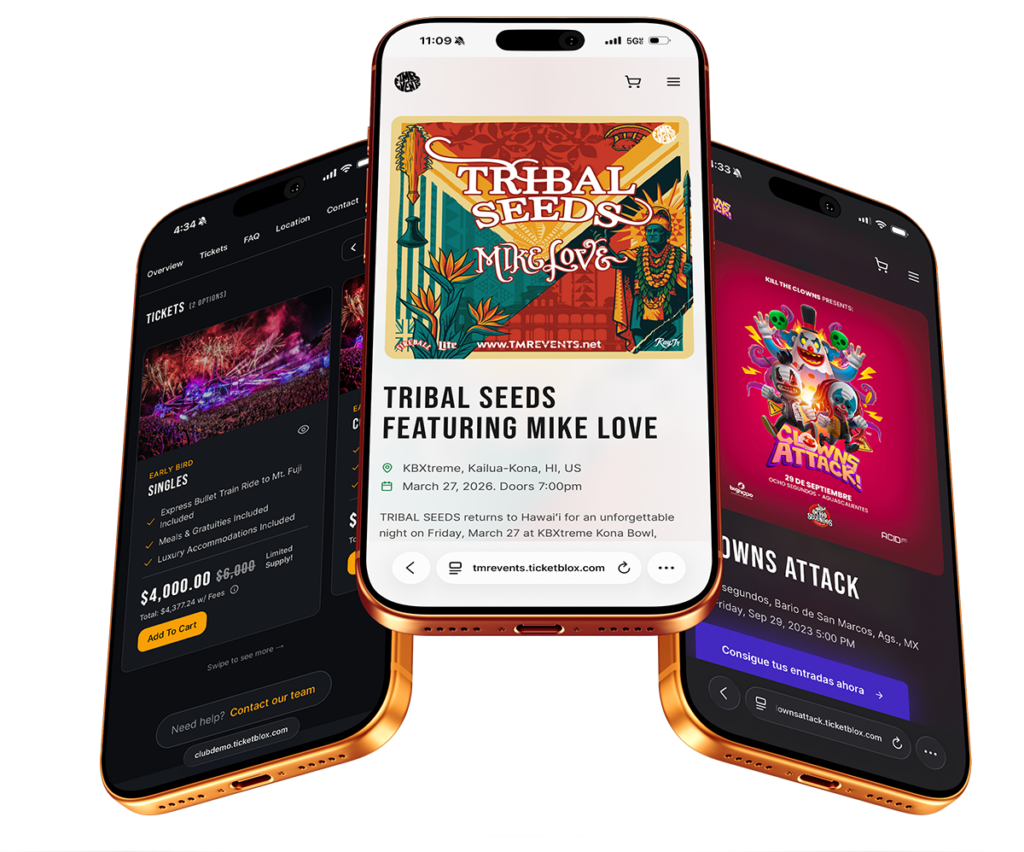
1. TicketBlox
TicketBlox positions itself as the “operating system for modern live events” and a "revenue growth ecosystem for Event promoters".
It’s an Enterprise, white‑label platform with no setup costs or monthly fees and gives promoters full control over branding, data and pricing.
Unlike many competitors, TicketBlox is built to monetize the customer relationship before, during and after the event, turning each ticket sale into a long‑term revenue channel.
The platform includes advanced tools such as:
- Transparent pricing & instant payouts: TicketBlox emphasises radical fee transparency and pays promoters within 24 hours. There are no hidden organizer fees, and you can choose to pass the modest transaction fee to attendees.
- Integrated CRM: The Boomerang! CRM lets you store unlimited contacts for free and run SMS/email campaigns on a pay‑as‑you‑send basis.
- Revenue amplifiers: TicketBlox’s revenue tools are designed to monetise every stage of the buyer journey. The platform bundles industry leading Upsells & Cross‑Sells, Payment Plan mark‑ups and Refund Protection so promoters can increase average order value, offer flexible payment options and protect themselves against chargebacks. These features work before, during and after the event to drive additional profit without undermining the attendee experience.
- Upcoming sponsorship matching: TicketBlox has announced plans for a Sponsorship Matching engine that will automatically connect promoters with brands and enable sponsored offers throughout the customer journey. When live, this will give organisers another revenue stream by embedding partner upsells into ticket purchase, communication and onsite experiences.
- Viral marketing: The Tribe feature turns buyers into influencers by rewarding them for sharing events
- Giveaway engine: Sweepstakes tools generate viral contests and capture leads without subscription fees.
- AI customer support: A built‑in AI assistant provides 24/7 support and reduces organiser overhead
Pros: TicketBlox is the only platform on this list that combines ticketing, CRM, influencer marketing and giveaways in one free‑to‑start package. It’s fully white‑labelled and pays out fast. The pay‑as‑you‑go model makes it viable for both small events and large festivals.
Cons: Because TicketBlox is newer than incumbents, it lacks the same brand recognition. Some advanced features (e.g. AI campaigns) may require learning time.
Best for: Organizers who want enterprise‑grade tools, own their brand and data, and need integrated marketing to maximize revenue.
2. Ticket Tailor
Ticket Tailor is well‑known for its zero‑fee option for free events. According to its own guide, the company is “totally free to use for free events…zero hidden fees, zero sign‑up fees and zero organiser fees”. If you charge for tickets, Ticket Tailor uses a flat per‑ticket pricing model and lets you decide whether to pass the fee onto attendees.
Key features include customisable event pages, reserved seating charts, time‑slot ticketing, a check‑in app and API integrations. The platform supports charities, festivals and attractions, and its optional open API appeals to developers.
Pros: Transparent flat‑fee pricing, no organiser fees for free events, flexible options for passing fees. Robust seating and product add‑on tools.
Cons: Lacks advanced marketing automation and CRM tools. Flat‑fee pricing may be higher than percentage‑based fees for low‑priced tickets.
Best for: Community events, charities and organisers seeking a simple, cost‑effective ticketing system with solid core features.
3. TicketSource
TicketSource markets itself as an easy‑to‑use platform with no fees for free events or in‑person bookings. For paid events, a small booking fee applies only to online tickets and includes card‑processing costs. Organisers can choose whether to absorb the fee or pass it onto customers. There are no contracts or hidden tiers, and full access to features such as seating plans, email/live chat support and a refund guarantee is included.
Pros: Free for free events, simple pricing, and full feature access without subscription. Good support and seating‑chart design tools.
Cons: Transaction fees for paid events are higher than some competitors (3.5% + 0.99 USD per ticket or 0.99 USD using your own Stripe account). Payouts may be delayed until after the event when using TicketSource’s payment processing.
Best for: Organisers who run mostly free events or small paid events and need a straightforward, contract‑free solution.
4. Purplepass
Purplepass emphasises flexibility and support across many event types. For free events, the company states that it does not charge any service fees. There are also no box‑office fees, comp ticket fees or limits on guest support. Promoters can control whether customers absorb fees or whether they’re included in the ticket price.
Purplepass offers assigned seating, time‑slot management, recurring events, on‑site reservation mode and printed materials. Organisers can process multiple payment methods and manage multi‑day events from one dashboard.
Pros: Free for free events, extensive seating and reservation options, strong box‑office capabilities and flexible fee‑absorption settings.
Cons: Per‑ticket fees for paid events can be higher than some alternatives; marketing and CRM features are limited.
Best for: Theatres, schools and venues requiring complex seating or multi‑day event management.
5. RSVPify
RSVPify straddles RSVP management and ticket sales. Its FAQ explains that the basic online RSVP service is free for events with up to 100 invitees. For ticketed events, RSVPify gives you access to its professional plan without an upgrade and charges 1.95% + $0.90 per ticket, allowing organisers to pass fees onto guests. Payments are processed through Stripe, with funds arriving within ~48 hours.
In addition to ticketing, RSVPify offers custom form builders, seating charts, donations and email invitations. It integrates with Salesforce, HubSpot and other tools.
Pros: Free for small RSVP‑only events, robust customisation and integration options, quick payouts through Stripe.
Cons: Free tier limited to 100 guests; per‑ticket fee slightly higher than some competitors; marketing automation is basic.
Best for: Weddings, corporate functions and private events that require RSVPs alongside ticket sales.
6. Eventbrite
Eventbrite is the largest name in ticketing. While you can publish unlimited events for free, paid tickets incur a 3.7 % + $1.79 service fee plus a 2.9 % payment‑processing fee per order. The company removed its old “Flex” plan, so there are no monthly subscriptions. Organisers can pass fees onto attendees or absorb them. Eventbrite integrates with social platforms, offers attendee email tools and provides a massive marketplace for discovery.
Pros: Enormous audience reach, intuitive interface, extensive integrations and marketing tools. Free to use for free events.
Cons: Highest per‑ticket fees on this list, complex fee structure that frequently changes. Payouts are typically delayed until after the event.
Best for: Large public events where visibility on the Eventbrite marketplace outweighs higher fees.
7. Zeffy
Zeffy focuses on nonprofit fundraising and is unique because it is completely free. The company’s help centre states that 100 % of donations go directly to your mission because Zeffy covers all transaction fees. Donors can optionally leave a contribution to support Zeffy’s operations, but there are no required platform or processing fees.
Zeffy supports events, raffles, auctions and memberships, integrates with Stripe, and provides tax‑receipt functionality. This makes it ideal for charities seeking to maximise fundraising revenue.
Pros: No platform or payment‑processing fees; nonprofit‑specific tools like tax receipts and peer‑to‑peer campaigns. Easy to use.
Cons: Only available to registered nonprofits; relies on donor contributions to fund the platform, so revenue sustainability may depend on donor generosity.
Best for: Nonprofits, schools and charities looking for a zero‑fee ticketing and fundraising solution.
8. EventCreate
EventCreate started as an event website builder and now offers a zero‑fee ticketing system. Its product page notes that selling tickets is more cost‑effective than ever thanks to a fee‑free ticketing system, meaning organisers can keep all ticket revenue. The company provides custom event websites, registration forms, check‑in apps, and the ability to sell add‑ons such as merchandise.
Pros: Free ticketing with no credit‑card processing fees; beautiful, customisable event websites; integrated check‑in and offline payment options.
Cons: Free tier may have limits on attendee numbers and events; advanced features (e.g. seating charts, team management) require paid plans.
Best for: Organisers who want to create polished event websites and manage RSVPs alongside ticket sales without sacrificing revenue.
9. TicketLeap
TicketLeap’s pricing philosophy is straightforward: full access to the platform is free when you pass a small ticketing fee to your buyers. The platform charges $1 + 2 % per ticket plus credit‑card processing, and allows you to offer $0.49 flat fees for tickets priced $5 or below. Free events never incur fees. There are no contracts, subscriptions or service tiers – every organiser gets full access to seating plans, mobile check‑in, tax settings and marketing tools.
Pros: Transparent flat‑fee pricing, no subscriptions, unlimited events and features. Reduced fees for low‑priced tickets and onsite sales.
Cons: Per‑ticket fees can add up for high‑priced events; payouts typically occur after the event (4–7 business days). Marketplace reach is smaller than Eventbrite’s.
Best for: Small to mid‑sized events where organisers want a contract‑free platform with consistent, predictable fees.
10. Ticketbud
Ticketbud promotes a fee‑free organiser model. Free events are completely free, and for paid events the 2 % + $0.99 ticketing fee can be passed onto attendees, making the platform free for organisers. There are no contracts, no pricing tiers and no subscription fees. The company emphasises that it only makes money when you do, and even nonprofits receive a discounted 1.75 % + $0.99 per ticket.
Ticketbud offers reserved seating, rentable hardware, integrations with Stripe and PayPal, marketing tools and on‑site check‑in. It provides calculators to show organisers their earnings and supports custom/white‑label solutions.
Pros: Free for organisers when fees are passed to buyers; no subscriptions; discounted nonprofit rate. Supports multiple payment processors and offers robust features for large events.
Cons: Fee structure includes both ticketing and payment‑processing fees; branding is controlled by Ticketbud unless you opt for custom solutions.
Best for: Organisers who want a versatile platform that remains free by passing fees to attendees, with the option to scale up to custom/white‑label solutions.
Which platform should you choose?
Selecting a ticketing platform depends on your goals.
If you’re a nonprofit that cannot afford any fees, Zeffy stands out with its zero‑fee promise.
For simple free events with limited marketing needs, Ticket Tailor, TicketSource and Purplepass provide straightforward, low‑cost options.
RSVPify is ideal when RSVPs and guest list management are your primary concerns.
EventCreate suits organisers who want beautiful event websites without losing revenue.
TicketLeap and Ticketbud offer predictable flat‑fee pricing for paid events and remain free when fees are passed on.
TicketBlox, however, goes beyond basic ticketing.
It combines gorgeous user experience, enterprise event setup - the best in the industry, fee transparency, instant payouts, CRM, viral marketing and AI‑powered tools under a single pay‑as‑you‑go model.
This makes it a compelling choice for promoters who view their events as mini‑economies rather than one‑off sales.
By owning your brand and data, leveraging influencer programmes and automating revenue boosters, you can turn every event into a growth engine.
Ready to see the difference? Get started with TicketBlox and discover what your event can achieve when you keep more of your money, own your audience and unlock advanced tools without hidden costs.